
A rare honey, an extraordinary price, and a cave story I still do not completely understand.
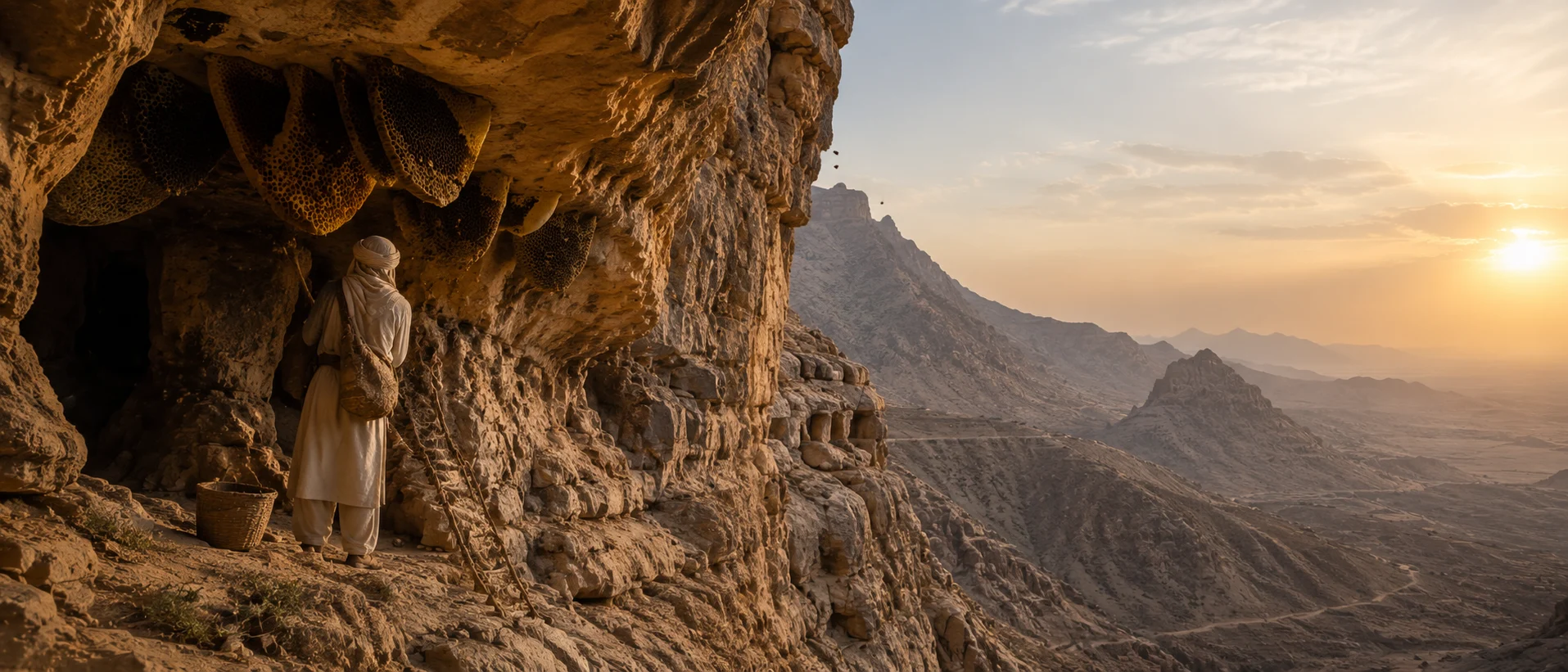
Some honeys begin with a tree. This one begins with a cave.
Yemen already occupies a special place in the world of honey. Say Yemeni honey and many people immediately think of Sidr, Do’an, thick amber jars and the extraordinary prices that certain harvests can command. But there is another expression that appears much less often outside specialist Gulf circles: Yemeni cave honey.
The name sounds almost too perfect for marketing. A wild hive hidden inside a mountain cave. Bees protected from the sun. A harvest reached only by people who know the mountains. A small amount of honey sold at a price that can exceed what many people would ever imagine paying for a jar.
And yet this is not merely an invented internet phrase. Yemeni cave honey is sold today as a distinct high-end product, with Wadi Amd in Hadramout especially associated with the story.
Wadi Amd is not Wadi Do’an
Before we go further, one distinction matters enormously. Wadi Amd and Wadi Do’an are not interchangeable names. Both are in Hadramout and both belong to the wider honey geography of Yemen, but they are different valleys.
Do’ani Sidr honey has become internationally famous. Wadi Amd cave honey is discussed as something more specific: honey harvested from wild colonies established in mountain caves or sheltered rocky cavities.
This distinction is useful for readers and for Google alike. Yemeni Sidr honey, Do’ani Sidr honey, Wadi Do’an honey, Wadi Amd honey, Yemeni cave honey and wild honey Yemen may overlap in conversation, but they do not automatically describe the same product.
What does cave honey actually mean?
Current specialist Gulf descriptions of Royal Cave honey present it as honey harvested from wild hives in mountain caves in Wadi Amd, Yemen, where the colonies are naturally sheltered by the surrounding rock.
That description gives us the basic idea: the cave is not supposed to be a decorative name for packaging. It refers to the physical location of the colony.
However, this immediately raises questions that deserve more than marketing language. Are the hives deep inside enclosed caves, beneath large rocky overhangs, inside fissures or in several kinds of natural cavities? Do all sellers use cave honey in exactly the same way? These are some of the questions that continue to interest me.
Wild honey does not automatically mean cave honey
Another term often used is wild honey. That usually suggests bees established outside managed conventional hives. But a wild colony does not necessarily live in a cave. It may occupy a hollow, rock cavity, tree or another protected place depending on species and environment.
So wild Yemeni honey and Yemeni cave honey should not be treated as perfect synonyms. Cave honey may be wild honey, but not every wild honey is cave honey.
This may sound like a small semantic point. It is not. Rare products become easy to exaggerate when several attractive words are allowed to mean whatever the seller wants.
Is Yemeni cave honey always Sidr?
Not necessarily from the words alone. Sidr honey refers to honey associated with nectar from Ziziphus trees. Cave honey describes where the colony is located. One term is botanical or floral; the other is physical and geographical.
A cave colony could forage on Sidr if Sidr is flowering within its foraging area. But the word cave itself does not prove Sidr dominance.
This is why a label such as Yemeni Sidr cave honey contains more information than cave honey alone. Even then, traceability matters.
The bees do not stay inside the cave
The romantic image can mislead us into imagining bees producing honey from something inside the mountain. They do not. The cave is the home of the colony. The bees still leave to forage on flowering plants outside.
That means the surrounding vegetation remains fundamental. The cave may protect comb and colony from sun, wind or temperature extremes, but nectar still comes from the landscape.
So if we want to understand Wadi Amd cave honey, we should eventually ask not only what the cave looks like, but what flowers are available around it during the harvest period.
Hadramout: a honey geography larger than one famous valley
International discussions of Yemeni honey often collapse Hadramout into Do’an. Do’an deserves its fame, but Hadramout is much larger than one valley and its beekeeping stories are more diverse.
Wadi Amd gives us another route into that geography. Instead of repeating Yemen Sidr honey as though every jar came from the same landscape, we can begin mapping valleys, elevations, flowering conditions and local harvesting practices.
That is more useful for anyone genuinely interested in Yemeni honey and much harder to fake with a luxury label.
Why would a cave colony be rare?
A wild colony inside a remote rocky area is not a standard apiary. Access itself may be difficult. The colony cannot necessarily be managed, multiplied or harvested with the regularity of conventional hives. The beekeeper or honey hunter may need local knowledge simply to reach it.
Harvesting also cannot be imagined as unlimited. A colony needs its stores. A sustainable harvest should not destroy the colony or remove everything the bees require.
When supply is tiny and access is difficult, rarity becomes physically understandable rather than merely promotional.
The price is real
This is where many European readers become suspicious, because the numbers sound almost absurd.
At the time of writing, Royal Cave honey can be found on the UAE luxury honey market at around 3,216 AED for 400 grams. That is more than 8,000 AED per kilogram at that pack price. Whatever one thinks about paying that amount for honey, prices at this level genuinely exist.
This matters because older articles discussing extraordinarily expensive Yemeni cave honey can look exaggerated if the reader has only ever seen supermarket honey. Current Gulf retail shows that a tiny ultra-premium market genuinely exists.
Price does not prove authenticity
An extraordinary price proves only that someone is asking an extraordinary price. It does not independently prove where the bees lived, how rare the harvest was or whether every claim surrounding the jar is correct.
This is why expensive honey deserves more questions, not fewer. Region, harvest, floral claim, beekeeper, batch, quantity, photos of the site, local knowledge and laboratory analysis can all contribute to a stronger story.
Luxury should increase the expectation of traceability.
An interesting inconsistency in modern product language
Even premium product descriptions can show why geographical precision matters. Some descriptions of Royal Cave honey identify Wadi Amd as the source in Yemen while other wording around similar products may refer to the better-known Do’ani Valley.
I do not know whether that is a template carry-over, a broader sourcing reference or something else. I would not pretend to know.
But it illustrates exactly why I keep separating Wadi Amd from Wadi Do’an. If we care about terroir, names should mean something.
Do’ani Sidr honey is a different story
Do’ani Sidr honey deserves its own reputation. It is associated with Wadi Do’an in Hadramout and is among the most internationally recognised Yemeni honeys.
But fame can create confusion. Once Do’ani becomes synonymous in consumers’ minds with best Yemeni honey, sellers may be tempted to attach the word too broadly.
A Wadi Amd cave honey should be allowed to be Wadi Amd cave honey without needing to borrow Do’an’s identity.
Osaimat, northern Yemen and other honey names
Yemen’s honey map also includes other names encountered in trade, including Osaimat and regional Sidr harvests from northern Yemen. There are also honeys associated with different flora and environments.
This is why the phrase Yemen honey is useful but incomplete. Yemeni honey can describe many origins and many floral stories.
The more serious the buyer, the more specific the questions should become.
Socotra is another world again
Socotra appears constantly in conversations about rare Yemeni honey because the island’s biodiversity is extraordinary. But Socotra honey should not be mixed casually into a Wadi Amd cave honey story simply because both sound exotic.
Socotra is geographically and ecologically distinct. Its honeys belong to another landscape.
Rare is not one category. Yemen contains several different reasons for rarity.
Kahouf, caves and the language people actually search
In French-speaking searches, terms such as miel de grotte du Yémen, miel sauvage du Yémen, miel de Kahouf, miel Yemen grotte and miel Sidr Yemen can all appear around the same curiosity.
Kahouf is often used online in relation to caves or cave honey. Search behaviour does not always respect botanical or geographical precision, which means a useful article should acknowledge the vocabulary people use while explaining where the terms diverge.
SEO should help clarify confusion, not merely repeat it.
A small scene in France
This honey remains so little known outside certain specialist circles that I once asked a honey specialist about it in France. His answer was immediate:
« Ah, le miel de grotte du Yémen ? I don’t know about it. »
I smiled. A little French in this story does no harm.
And perhaps his answer says more than it seems. We are talking about a honey that can command extraordinary prices in Dubai and the Gulf while remaining almost unknown to many honey professionals in Europe.
Why the Gulf understands this product better
The UAE, Qatar and the wider Gulf are natural markets for extremely premium Yemeni honey. Yemeni Sidr already has cultural recognition here. Buyers are familiar with luxury honey gifting, Arabic coffee, dates, oud, rare food products and the idea that origin can justify a very high price.
That does not mean every customer in Dubai or Doha wants a 3,000 AED jar. Of course not. It means there is a market segment capable of understanding and buying such a product.
This is why searches such as Yemeni honey Dubai, Yemen Sidr UAE, cave honey Dubai, rare honey UAE, Yemeni Sidr Abu Dhabi, Yemen honey Qatar and premium Sidr Qatar make commercial sense.
Dubai is the market, Yemen is the origin
A jar can be sold in Dubai for thousands of dirhams and still remain Yemeni honey. A shop address does not change where the bees foraged.
Likewise, Yemeni cave honey in Qatar remains Yemeni cave honey. Emirati customers, Qatari customers or Saudi customers do not give the jar a new botanical origin.
This distinction sounds obvious, but it is one of the most useful ways to organise Gulf honey SEO honestly.
Who buys a honey this expensive?
I would be careful with the claim that the only customers are in the Emirates or Qatar. Wealthy collectors and enthusiasts exist elsewhere.
But it is reasonable to say that Dubai, Abu Dhabi, Doha and the Gulf provide one of the most visible markets for ultra-premium Yemeni honey. The region combines purchasing power with cultural familiarity with Sidr and prestige food gifts.
Europe has luxury food too, but Yemeni Sidr does not occupy the same cultural place there.
A breakfast honey? Probably not for most people
At more than 3,000 AED for 400 grams in a current luxury listing, this is not the jar most people will spread over toast every morning.
It becomes something closer to a collector’s food, a prestigious gift, a curiosity or a product bought by someone deeply interested in rare Yemeni honey.
And this raises a funny question: after all the mountains, caves, rarity and price, does somebody still eventually put a spoonful on bread? Probably. Honey always finds its way back to food.
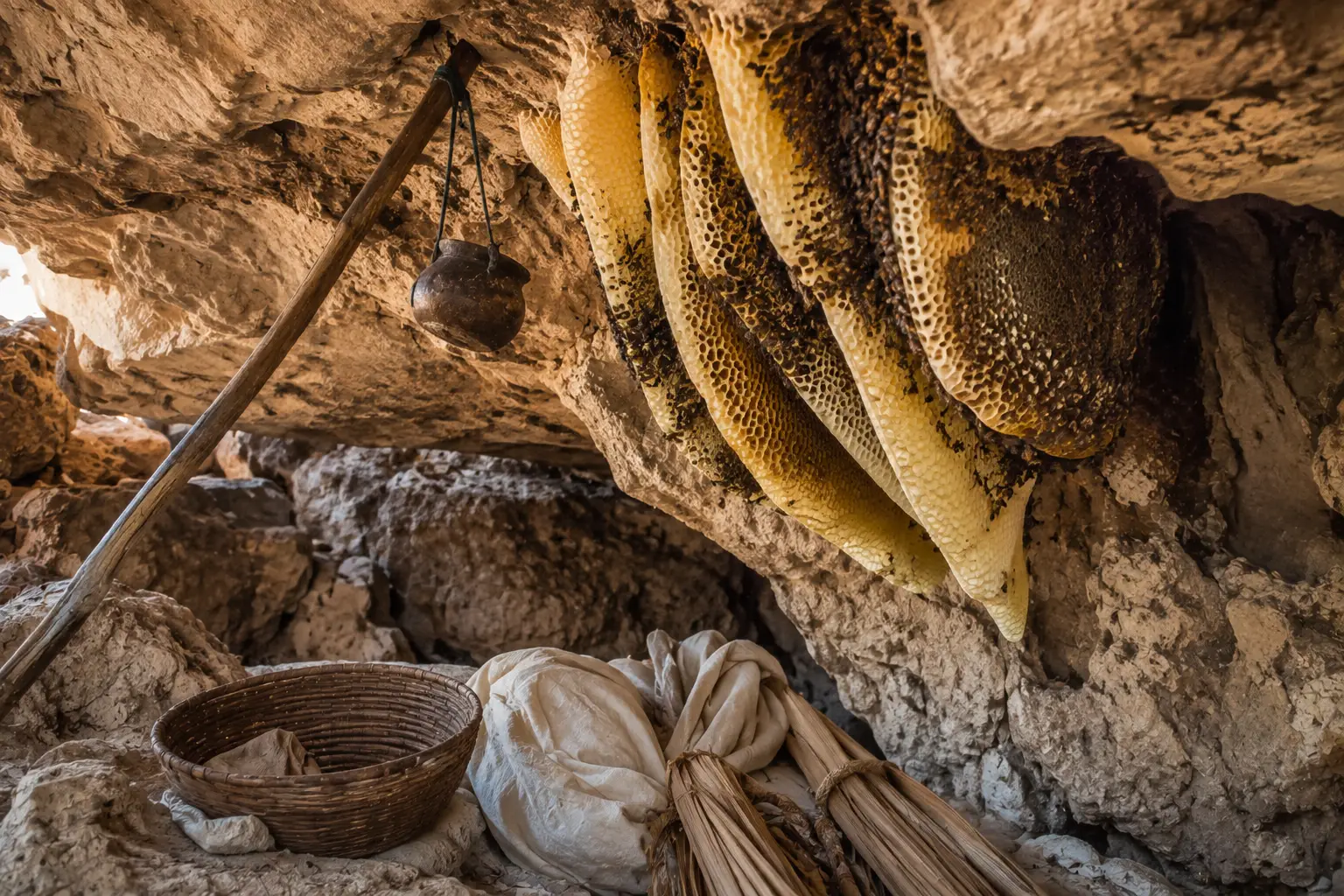
Can colour prove cave origin?
No. A thick texture, amber colour or powerful aroma cannot independently prove that a honey came from a cave in Wadi Amd.
Honey varies with flora, moisture, crystallisation, temperature and handling. Sensory characteristics can be interesting, but they are not GPS coordinates.
If a seller wants us to believe a remarkable geographical story, the evidence should be geographical too.
Can laboratory testing prove a cave?
Laboratory testing can tell us useful things about honey quality and, depending on the analysis, botanical markers, pollen profile, moisture, HMF, enzymes and other characteristics.
But a laboratory cannot simply print this hive was inside a cave in Wadi Amd from a generic honey sample. The cave claim ultimately depends on traceability to the harvesting location.
Science and provenance need each other.
What would I ask the beekeeper?
If I had the chance to speak directly with someone harvesting this honey, my questions would be simple. Where exactly are the colonies located? What do local people call these caves? Are they deep caves, rock shelters or fissures? How long have the colonies occupied them? What flowers dominate nearby? How often can honey be harvested without harming the colony?
I would also ask how much honey one colony actually yields, how harvesters reach the sites, whether smoke is used, how comb is removed and how local people distinguish genuine cave honey from ordinary regional honey.
Those answers would teach me more than another luxury adjective.
The people of Wadi Amd matter more than the packaging
The most valuable knowledge about these caves may not be written in English or French at all. It may live with families, beekeepers and people who know the mountains.
This is why I dislike articles that sound certain simply because they copied several commercial pages. A product description can tell us how a seller presents the honey. It cannot replace local memory.
If MESKI ever learns more about Wadi Amd cave honey, I hope some of that knowledge comes from Yemen itself.
Could cave honey describe several realities?
This is one of my biggest questions. When different sellers and communities use the term cave honey, are they describing the same kind of hive location? Or does the label cover several forms of natural rock shelter?
A true cavern, a narrow crevice and a protected overhang may all look very different while still being casually described in another language as a cave.
Until I hear from people who know the area directly, I prefer to leave the question open.
Rare does not mean medicinal miracle
Yemeni honey is often surrounded by strong health claims. Rare honey attracts even stronger ones.
At MESKI, I would separate cultural use and commercial claims from medical proof. Honey is a food with interesting composition, but rarity, price and origin do not automatically turn it into a treatment for disease.
If a claim sounds medical, it deserves medical evidence, not only tradition or price.
The story is already extraordinary without exaggeration
We do not need to invent powers for this honey. A wild colony living in a remote Hadrami mountain cavity, producing a tiny harvest that local people reach with difficulty, is already a remarkable story.
The landscape, the bees, the people and the scarcity are enough.
Sometimes marketing weakens a story by refusing to believe reality is interesting enough.
A honey almost nobody will taste
The strange thing about writing thousands of words about Yemeni cave honey is that most readers will probably never taste it.
Perhaps that increases the fascination. We are used to writing about food so people can buy it. Here, curiosity may be the only thing many of us can afford.
And I include myself in that sentence.
Meskaoui: I have never tasted it
“I have never tasted this honey. At its price, I have never been able to justify buying a jar simply out of curiosity.”
“But perhaps that is also why it continues to intrigue me.”
“I keep wondering about these caves. What are they really like? Are they entirely natural formations? How do the bee colonies establish themselves inside them? Are all the photographs and stories we see describing the same type of place, or has the expression ‘cave honey’ gradually come to describe several different realities?”
“I can read what merchants say. I can look at photographs. I can search through what has been written about Wadi Amd. But that is not the same as hearing from someone who actually knows these mountains.”
“If you are from Wadi Amd, Hadramout, or this part of Yemen, and you know these caves, these bees or the people who harvest this honey, I would genuinely love to hear from you.”
“Some questions are better answered by the people who live where the story began.”
— Meskaoui
And perhaps that is the right ending
Yemeni cave honey may be one of the world’s most expensive honey curiosities, but price is not what keeps me thinking about it.
It is the cave.
Somewhere in Hadramout there may be a colony hidden in rock, bees leaving every morning toward flowers we have not yet properly described, while far away in Dubai a glass jar waits under perfect shop lighting with a price higher than many people’s monthly salary.
Between those two places is the real story I still want to understand.
From Yemen to Dubai: how a rare honey changes context
A jar leaving Hadramout and arriving in Dubai enters a completely different world. In Yemen, the important question begins with the colony, the mountain, the flowering season and the people who know where the hive is. In Dubai, the same jar may sit inside polished retail lighting beside gold packaging, premium dates, oud and luxury gifts.
Neither world is false. The problem begins only when the second world erases the first. The more refined the presentation becomes, the more I want the original landscape to remain visible.
Yemeni honey in Abu Dhabi
Abu Dhabi is another natural market for high-value Arabian honey. Customers familiar with Emirati Sidr, Omani honey and premium Gulf gifts can also understand why a Yemeni harvest might command an exceptional price. This gives us natural search combinations such as Yemeni honey Abu Dhabi, Yemen Sidr Abu Dhabi and premium Yemeni honey UAE.
Again, Abu Dhabi describes where the customer finds the jar, not where the bee found the flower.
Yemeni honey in Qatar
Qatar follows the same logic. Doha has a strong culture of majlis hospitality, dates, Arabic coffee and premium food gifting. Yemeni Sidr is already understood in that environment, which makes rare Yemen honey and Yemeni cave honey commercially intelligible even when the product itself is scarce.
Someone searching Yemeni honey Qatar may be looking for ordinary Sidr, Do’ani honey, a luxury gift or something as unusual as cave honey. A useful article should help that person distinguish the categories.
Saudi Arabia and the regional honey conversation
Saudi Arabia has its own important honey traditions, including Sidr and other regional harvests. That makes the Gulf honey market interesting: customers can compare Yemeni, Saudi, Omani and Emirati origins without pretending they are interchangeable.
A rare Yemeni cave honey does not become more authentic because it is compared with Saudi honey. Each origin should stand on its own traceability.
Why ‘best Yemeni honey’ is a difficult question
Search engines love the word best. People ask for the best Yemeni honey, best Sidr honey Yemen, best honey from Yemen and the most expensive honey in Yemen. But these are not identical questions.
The best tasting honey for one person may not be the rarest. The most expensive may not be the best documented. A Do’ani Sidr may have stronger traceability than an obscure cave-honey claim. A lower-priced regional honey may simply suit someone’s palate better.
Best needs a criterion before it becomes useful.
Rare honey and the psychology of price
Extremely high prices create their own mythology. Once a jar costs thousands of dirhams, people assume the taste must be unlike anything else, the health benefits must be extraordinary and the origin must be unquestionable. None of those conclusions follows automatically from price.
Price can reflect supply, prestige, demand, retailer positioning and the difficulty of sourcing. It can be justified, inflated or both. The only responsible approach is to separate each claim and examine it on its own.
If I ever tasted it, what would I compare?
If one day I finally taste a genuine Wadi Amd cave honey, I would not begin by asking whether it is ‘worth’ 3,216 AED. Taste cannot answer a pricing model. I would compare aroma, sweetness, bitterness, acidity, texture, persistence and how it differs from traceable Do’ani Sidr, Omani Sidr or Emirati Sidr.
Then I would ask whether the sensory experience tells me anything useful about origin. Probably less than people expect. The story would still need evidence outside my tongue.
Why Ahuney’s old article still makes sense
Years ago, Ahuney published a French article specifically about miel sauvage de grotte du Yémen. Its strength was not sophistication. It was focus. The page repeated Yemen, cave, wild honey, Sidr and local names with very little ambiguity about its subject.
That old page is a reminder that SEO sometimes rewards clarity before elegance. With MESKI, I want to keep that clarity while adding what the older article could not: better distinctions, stronger sourcing, more geography and the honesty to say when we still do not know.
One article, many searches, one real subject
This is why I am comfortable using many variants in one long article: Yemeni cave honey, Wadi Amd honey, Yemen wild honey, Sidr honey Yemen, Yemeni honey Dubai, Yemen honey UAE, Yemeni honey Qatar, premium honey Abu Dhabi and rare Yemen honey. They are not random keywords when the article actually explains the relationships between them.
The danger is not using many words. The danger is using them without adding meaning.
The question I cannot answer from France or Dubai
I can verify that a luxury retailer sells Royal Cave honey at an extraordinary price. I can verify that Wadi Amd is the place named in the product description. I can compare older articles and modern sales language. What I cannot verify from a desk is the exact physical form of every cave, how each colony is reached or whether local terminology maps neatly onto the English phrase cave honey.
That missing piece is not a weakness in the article. It is the most interesting part of it.
Yemeni Cave Honey FAQ
Honey described as harvested from wild bee colonies established in natural mountain caves or rocky cavities in Yemen, especially associated commercially with Wadi Amd in Hadramout.
Wadi Amd is in Hadramout, Yemen. It is distinct from Wadi Do’an.
No. Wadi Amd and Wadi Do’an are different valleys, and cave honey should not automatically be labelled Do’ani.
No. Cave describes the colony location, while Sidr describes a floral source. A cave honey may be Sidr if bees forage predominantly on Sidr.
Usually honey from colonies living outside conventional managed hives. Wild honey is broader than cave honey.
Rarity, difficult access, low supply, prestige and specialist Gulf demand can all contribute to very high prices.
At the time of writing, Royal Cave honey can be found in the UAE luxury market at around 3,216 AED for 400 g. Prices and sizes can change.
Yes, specialist retailers in the UAE sell ultra-premium Yemeni cave honey.
No. Dubai is the market; the harvest origin remains Yemen.
Yemeni Sidr and other premium Yemeni honeys are sold in Gulf markets including Qatar, though exact cave-honey availability varies.
No. Colour, thickness and taste alone cannot prove a cave origin.
Not by itself. Lab tests can support quality and floral analysis, but cave provenance requires traceability to the harvest location.
The term appears in French and online discussions of Yemeni cave honey, but terminology can vary. It should be tied to a specific local origin rather than treated as a universal scientific category.
Honey has nutritional and biochemical properties, but rarity and high price do not prove treatment claims for disease.
They come from different valleys in Hadramout. Do’an is famous for Sidr; Wadi Amd is especially associated in premium trade with cave-honey stories.
Continue the Journey
If this story brought you here, continue the journey through related stories from The House of Meski.