
You can buy honey almost anywhere in Dubai. The real skill is knowing whether you want local, imported, raw, commercial, everyday or luxury gift honey.
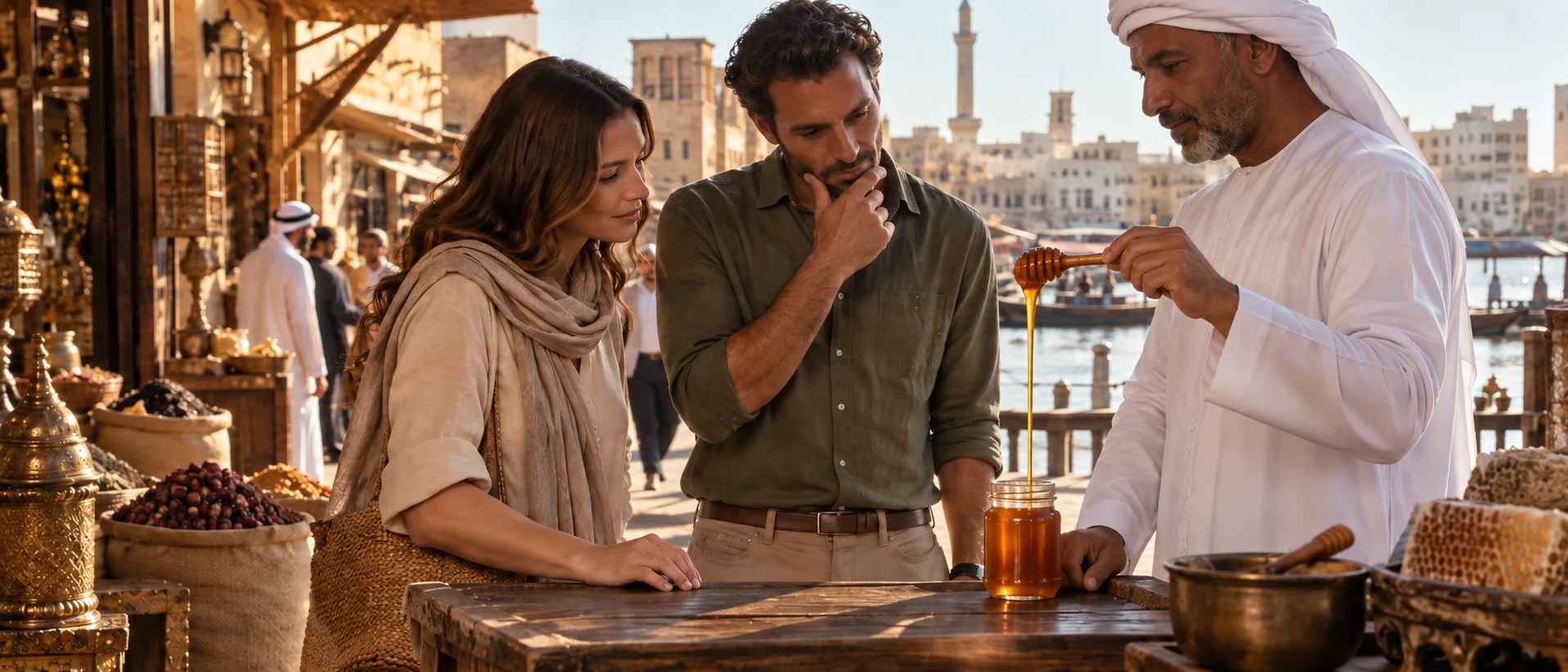
You can buy honey almost everywhere in Dubai. The difficult part is knowing what you are actually buying. Dubai gives you everything at once: Emirati Sidr, Yemeni Sidr, Omani honey, supermarket jars, raw-honey claims, traditional-looking pots, luxury boxes and online delivery. This guide is not here to tell you one shop is sacred. It is here to help you ask better questions.
Dubai Is the Easy Part
You can buy honey almost everywhere in Dubai. That is not the challenge.
The challenge is deciding what you actually want before the jars begin shouting at you.
A supermarket shelf may offer everyday commercial honey beside imported premium origins. A traditional market may offer jars described as raw, mountain or wild. A specialist seller may focus on Yemen, Oman or UAE harvests. A luxury shop may turn the jar into a gift.
None of those formats is automatically good or bad. They answer different needs.
In Dubai, finding honey is easy. Finding the honey you actually meant to buy is the real shopping trip.
Meskaoui
Local Emirati or Imported?
If you want Emirati honey, ask for UAE origin clearly.
Local Sidr and Samar are real Emirati honey categories. UAE research has examined monofloral Sidr, Samar, Ghaf and Neem honeys, while the Ministry supports beekeeping as part of local food production and biodiversity.
If you want Yemeni Sidr, Omani Sidr, Saudi honey or Moroccan jujube honey, those are different origins.
The word Sidr alone does not tell the whole story. That is why we built our World of Sidr guide.
Imported Does Not Mean Fake
Dubai is a city built around movement. Honey arrives here from across the region and far beyond it.
Yemeni honey sold in Dubai can be completely genuine Yemeni honey. Omani honey does not become Emirati because the shop is in Jumeirah. A Moroccan jar does not become Dubai honey because it was delivered from Downtown.
Authenticity means the declared origin should be true.
Local and imported are different questions, not good and bad.
Raw, Traditional and Commercial Are Different Questions
People mix these words too easily.
Raw usually refers to limited heating or processing, although definitions and handling vary.
Traditional may describe harvest, presentation or selling context.
Commercial describes participation in organised retail or larger scale trade.
A commercially sold honey can still be excellent. A rustic jar can still tell you almost nothing about processing.
Old-looking packaging is not a laboratory test.
Old Dubai Is for the Market Experience
Dubai Spice Souk is a natural place to feel the older trading character of the city. Visit Dubai describes it as a traditional Deira market of spices, herbs and aromatic goods.
Naif adds another nearby layer of everyday shopping and souvenirs.
Go for comparison, conversation, smell and discovery.
But do not let the atmosphere answer the provenance question for you.
A jar does not become authentic because it looks as if it travelled by camel.
Specialist Honey Shops Let You Ask Better Questions
Ask the country.
Ask the region if the seller claims a specific one.
Ask about harvest year if it matters to you.
Ask whether the seller knows the producer or beekeeper.
Ask how the batch is traced.
Ask what raw means in that seller’s own process.
The quality of the answer often matters more than the beauty of the shelf.
Supermarkets Have a Legitimate Place
Sometimes you want honey for breakfast, cooking or family use.
A supermarket may be the correct answer.
You can compare price, labels, declared origin and packaging in a straightforward way.
The mistake is not buying in a supermarket.
The mistake is demanding that an everyday mass-market jar answer the same desire as a limited single-origin harvest.
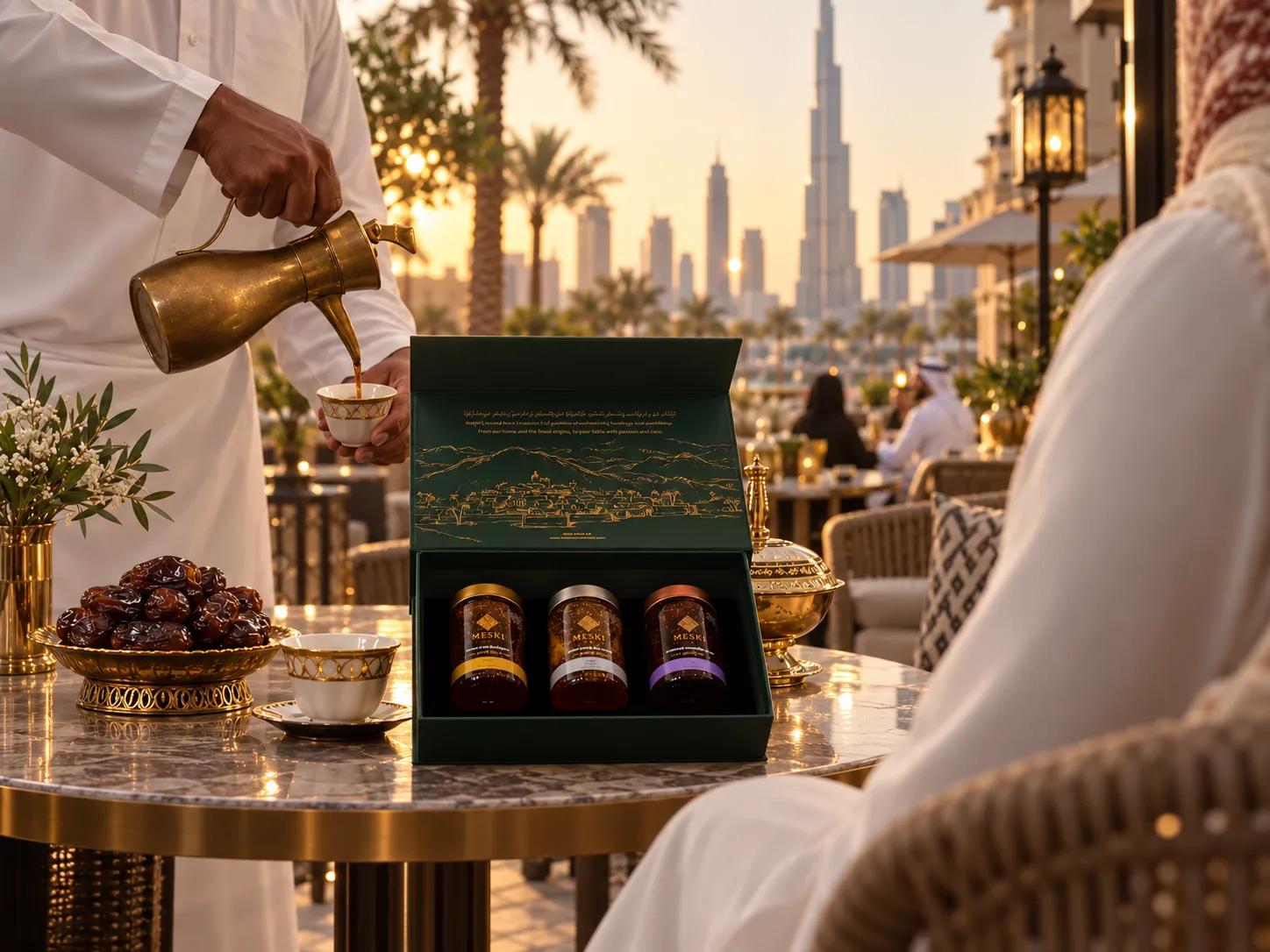
Jumeirah and Downtown Answer the Gift Question
In Jumeirah, Downtown and the major hotel districts, honey enters the world of gifting.
A host gift, corporate gift or VIP set asks for more than flavour. Presentation, consistency, availability and delivery suddenly matter.
We use luxury presentation at MESKI too, so I am not going to pretend a beautiful box is suspicious.
The problem begins only when presentation is asked to prove origin.
Gold, velvet, wood and heavy glass can honour a true product. They cannot tell you where the bees flew.
Online Is Often the Most Dubai Answer
Dubai is a delivery city.
Online buying is practical for gifts, repeat orders and people who already know the honey they want.
That makes origin pages, batch details, shipping conditions and product descriptions more important because you cannot hold the jar before buying.
Our MESKI shop answers the purchase question. The Journal is here to answer the curiosity behind it.
What to Ask Before Paying
Country of origin.
Floral source.
Local UAE or imported.
Harvest and handling if raw honey matters to you.
Batch traceability.
Which exact batch any analysis belongs to.
Whether the seller can connect the document and the jar in front of you.
Those questions beat a beautiful box every time.
A Laboratory Report Is Useful, but It Is Not Magic
A laboratory report can be useful, but it is only as valuable as the traceability behind it.
Testing one sample does not automatically prove the identity of every jar later sold under the same name.
Analysis may examine moisture, sugars, HMF, acidity, enzyme activity, pollen and other authenticity indicators depending on the method.
Modern research also discusses isotope and molecular approaches.
But the report still has to belong to the product you are buying.
Rustic Packaging Is Not Magic Either
Some buyers distrust luxury and run toward the opposite visual language.
A plain jar, old-style label, wooden lid or story about a mountain can feel more authentic.
Sometimes it is.
Sometimes it is simply another presentation choice.
Raw processing has no compulsory costume.
Authenticity does not have one aesthetic.
Yemeni Sidr in Dubai
Yemeni Sidr carries enormous reputation in the regional market.
That is exactly why declared origin deserves attention.
If a jar says Yemen, I want Yemen to mean Yemen.
I want the supplier story, region and traceability to make sense.
Our Do’ani Sidr Honey is one way we present a specific Yemeni origin. It is not a template every Yemeni honey has to copy.
Emirati Sidr in Dubai
Emirati Sidr tells a different story because it can be genuinely local to the UAE.
Visit Dubai highlights Emirates Beekeepers in Hatta as a destination connected with Emirati honey and beekeeping.
Our Hatta guide approaches the subject from landscape and beekeeper first.
If local origin matters to you, ask specifically for Emirati honey. Do not assume anything sold inside Dubai was harvested inside Dubai.
Do Not Forget Samar
Sidr gets most of the fame, but Samar matters deeply to UAE beekeeping.
The Ministry describes Samar as a drought-tolerant native tree found on sandy and gravel plains, wadis and mountain slopes, and identifies it as an important nectar source for bees.
We keep Omani Samar separate from Sidr because it deserves its own flavour and botanical story.
One famous honey should not erase the rest of the landscape.
For Yourself or for a Gift?
If the jar is for you, taste may lead.
If it is a gift, presentation becomes part of the experience.
If it is corporate or VIP, availability and consistency matter.
If the recipient cares deeply about origin, give them the provenance story as well as the box.
One jar cannot optimise every priority.
Amanah Before Sales
For us, provenance is an amanah.
A customer may never discover a deception. That does not make the deception invisible.
Allah knows what is hidden as well as what is shown.
I prefer to use that sentence as a rule for ourselves, not as an accusation against another seller.
We cannot control every jar in Dubai. We can control what we say about ours.
A beautiful box can honour a true honey. It should never be asked to replace the truth.
Meskaoui
So Where Should You Buy Honey in Dubai?
Wherever you feel comfortable.
MESKI could tell you to buy MESKI. That would be very convenient for us.
But no.
Buy from us, buy from somebody else, buy in a souq, a specialist shop, a supermarket or online.
We are not in competition with everyone who sells honey.
Know what you want, ask about origin and traceability, and do not confuse packaging with proof.
Rizq reaches where it is written.
Signed, MESKI.
Sources and Buying Notes
Visit Dubai documents the Spice Souk, Naif Souk and Emirates Beekeepers in Hatta as current visitor and shopping contexts.
The UAE Ministry documents support for beekeeping and local honey production.
United Arab Emirates University research has examined monofloral Emirati Sidr, Samar, Ghaf and Neem honeys.
A recent scientific review discusses Sidr and Samar honey in UAE arid ecosystems and modern authenticity tools.
This guide does not certify third-party sellers. It gives buyers a framework for asking better questions.
Questions People Ask
Specialist honey shops, traditional markets, supermarkets, premium food retail and online all sell honey. The right place depends on origin, budget, convenience and gifting.
No. Dubai sells both local UAE honey and imported honey from Yemen, Oman, Saudi Arabia, Morocco and many other origins.
Ask for clear origin information, batch traceability and documentation that can be linked to the actual batch being sold.
Not by itself. A report is strongest when it is linked to the specific batch and supply chain.
No. Rustic packaging and processing are separate questions.
Specialist sellers, premium food stores, online gifting and luxury districts such as Jumeirah and Downtown are logical places to compare presentation.
They come from different countries and terroirs. Both may be premium, but the origin should be declared honestly.
Yes. Samar is an important UAE nectar tree and a recognised source of local honey.
No. Buy wherever you trust the origin, traceability, flavour and seller.
Know the Honey Before the Box
Continue through Sidr origins, Hatta, authenticity and the MESKI Honey Atlas before choosing your next jar.