Object of Memory
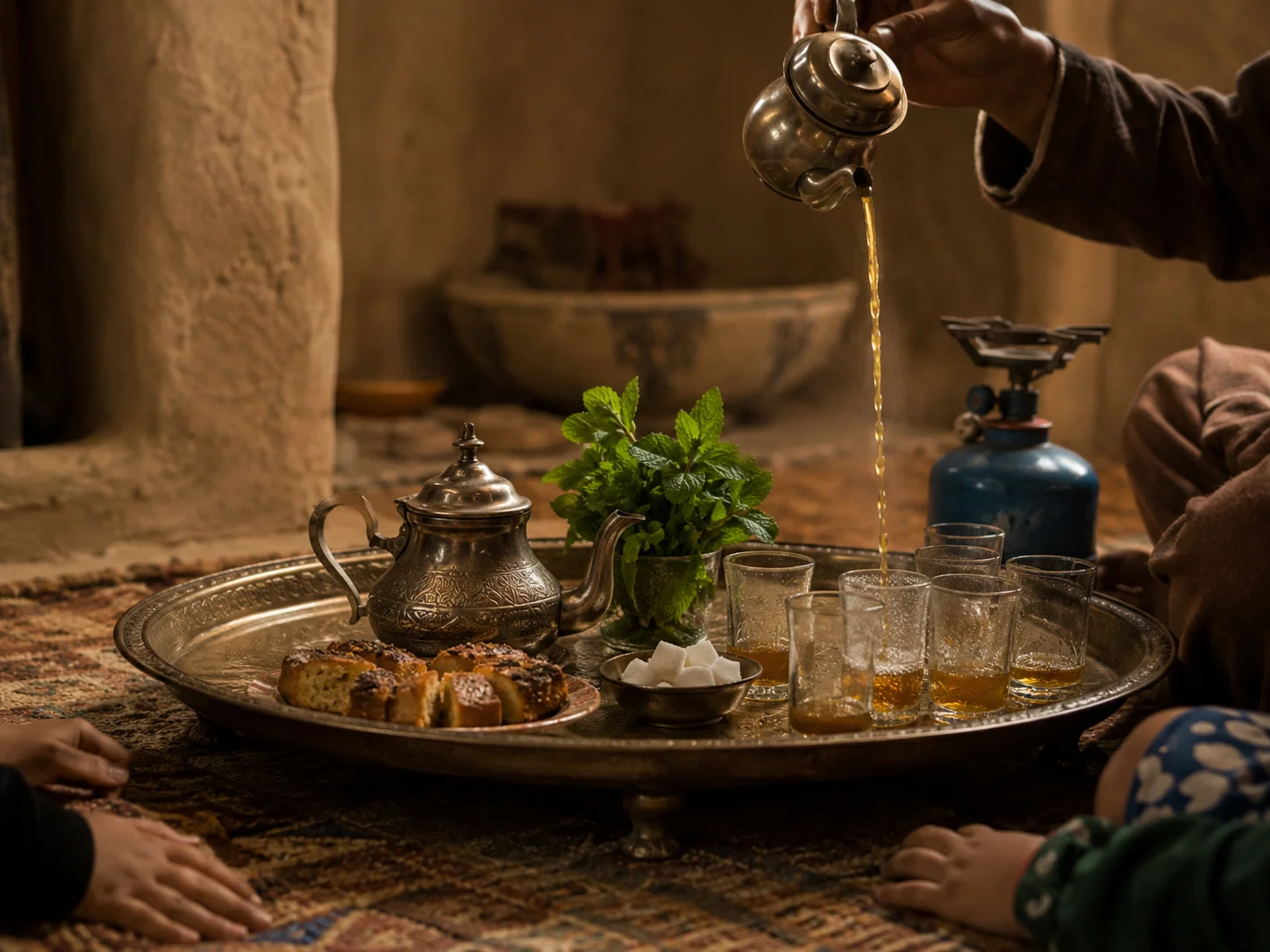
The Brass Tea Tray
The tray had already been prepared before the first guest arrived. One object was enough to tell the house that it was time to welcome.
There are places we remember because they were beautiful. Others remain because, within their walls, we first understood what it meant to belong.
The grand salon was the largest room in our family house, but size was never what made it grand. It was grand because the door was rarely closed. It was grand because people entered carrying news, dust from the road, laughter, worry, hunger, blessings and stories from places I could only imagine. It was grand because every person who crossed its threshold was given a place.
As a child, I did not think of it as a room with walls. To me it was a world. The rest of the house belonged to the rhythm of family life: sleeping, cooking, washing, whispering, quarrelling, forgiving. The grand salon belonged to everyone. It was where the private life of our home opened toward the village.
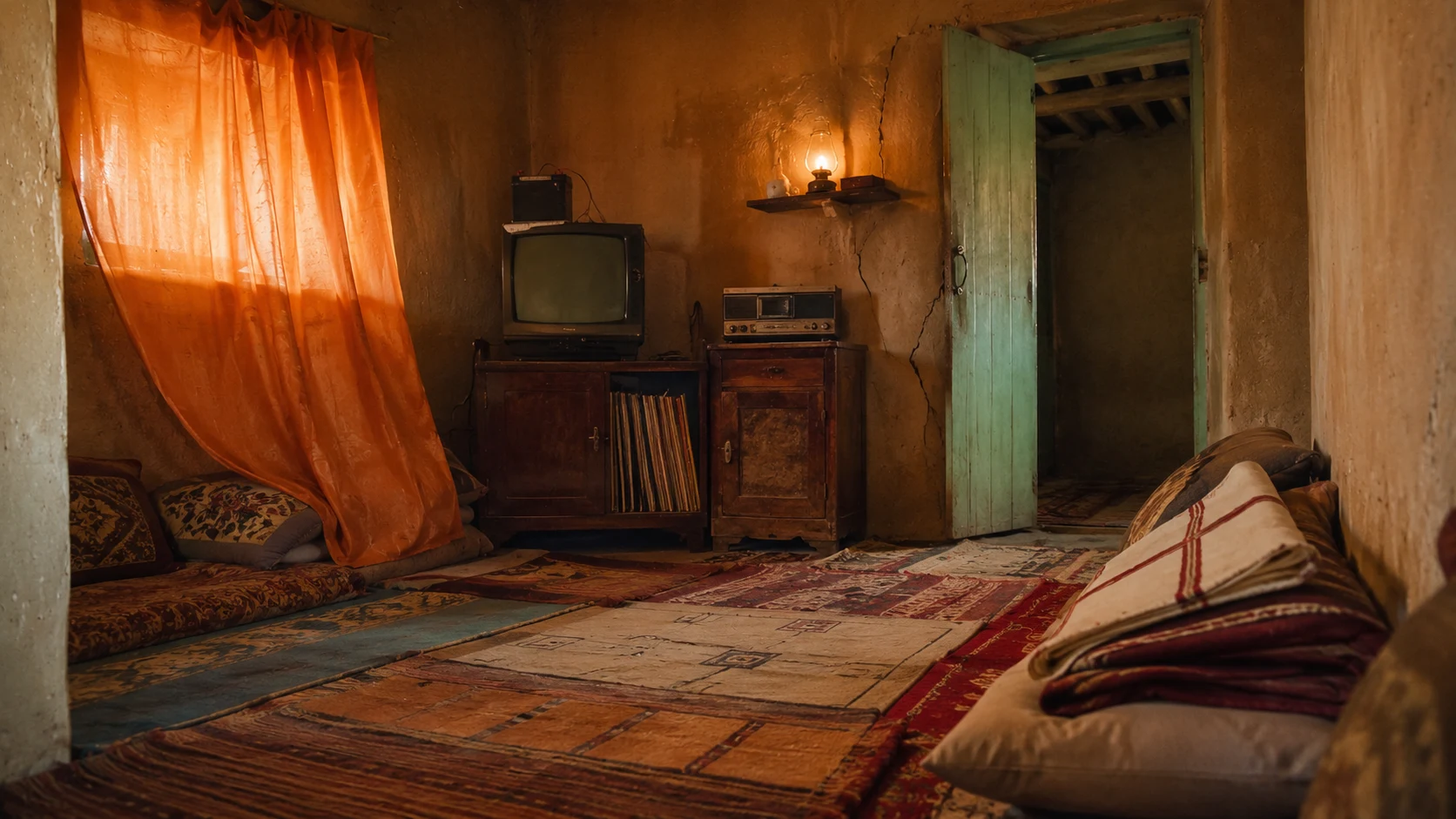
I remember the floor before I remember the ceiling. The carpets covered nearly everything. Some were thick, some worn smooth by years of knees, feet and hands. Along the walls ran cushions that seemed to continue without end. Adults sat against them, children folded themselves into the spaces between bodies, and late arrivals always found room as though the salon had quietly expanded for them.
The house itself was not a palace. We did not need it to be. Its dignity came from use. A wall marked by time was not ugly. A carpet faded by guests was not old. A tray darkened by countless glasses of tea was not something to replace. These were the signs that a home had fulfilled its duty.
Before visitors arrived, the room changed. Nothing dramatic happened, yet the entire house seemed to lean toward the salon. Someone straightened a cushion. Someone swept the floor again, even if it had already been swept. Bread was counted. Tea was prepared. A child was sent to the small shop if sugar, mint, biscuits or anything else was missing. No one asked whether the guests would stay long enough to justify the effort. Their arrival was justification enough.
The House Begins to Listen
There was always a moment, just before the first knock or greeting, when the house seemed to listen. The courtyard held its breath. Voices became alert. Footsteps moved with purpose. Then the entrance filled with salutations, questions, blessings and names repeated with affection. A guest never simply appeared. He arrived through a small ceremony of recognition.
The adults greeted one another with a fullness that children rarely understand. They asked about health, parents, children, journeys, harvests and people absent from the room. A greeting could take time because a person was never received alone; he arrived carrying the invisible presence of his family and his village.
From the doorway, I watched faces change. A tired traveller might enter with the road still upon him, then soften as soon as he sat down. A worried relative could be silent for several minutes before the conversation reached the reason for his visit. Someone returning after a long absence would be examined with affection: his face, his health, the changes in his voice. In the salon, people were not processed. They were received.
The room filled gradually. Robes settled against the cushions. Sandals remained near the entrance. Hands moved as people spoke. Some voices were deep and measured; others rose quickly, carrying an entire argument across the room. Laughter travelled in waves. A story begun at one end might be corrected from the other. The older men remembered names and events from years before my birth. I listened without knowing which details were history and which had been polished by repetition.
As children, we were not at the centre, but we were never entirely excluded. We belonged to the edges. The entrance, the corners, the narrow spaces beside the cushions—these were our territories. From there, we learned to read the room. We knew when laughter gave us permission to come closer. We knew when an adult conversation required silence. We knew when a glance meant: bring the tray, move the glass, fetch water, call someone.
No one gathered us for a lesson on hospitality. No one delivered a speech. We learned through movement. We learned by watching who was served first. We learned that the oldest guest was approached with care. We learned that a tray should not be placed carelessly. We learned that an empty glass was a question. We learned to notice before being told.
The Ceremony of Tea
Tea entered the salon like a second guest.
I remember the round trays, the small glasses, the shine of metal under lamplight and, beside the person responsible for tea, the bottle of gas that made the preparation possible. The tea was not hidden away in a distant kitchen. It was often prepared in the presence of the gathering, where everyone could see the sequence unfold: water, leaves, mint, sugar, heat, patience.
The person making tea held a temporary authority. Conversation continued around him, but his work created its own centre. He lifted the pot, watched the colour, judged the sweetness and poured from a height that seemed astonishing to a child. The thin amber stream entered each glass with foam rising at the surface. Nothing was rushed. Even when many people waited, haste would have diminished the welcome.
The first glasses did not belong to us children. We understood that. They travelled toward the guests, then the elders, then the other adults. Only afterward did they reach the entrance where we waited. Yet the delay did not make us feel forgotten. It made the glass more precious. By the time one was handed to us, we had watched its entire journey.
Sometimes the tea was so hot that I held the glass by the rim, moving it from one hand to the other. The sweetness arrived before the bitterness. Mint rose with the steam. Around me, the adults continued speaking as though tea had always been present, though I could feel that the room had settled after the first round. Hospitality had found its rhythm.
There were biscuits when we had them, bread, dates, perhaps nuts or something prepared in the house. But abundance was never measured by variety. The essential thing was that what existed should circulate. A modest plate placed before others with an open heart carried more honour than a table arranged only to impress.
I remember how carefully we watched the tray. Children notice what adults overlook: the glass with the most foam, the biscuit that remained untouched, the guest who refused once before accepting, the hand that discreetly pushed something toward another person. These small gestures formed our earliest understanding of generosity.
The Children at the Entrance
We did not sit where the oldest men sat. We remained near the doorway, close enough to serve and far enough not to interrupt. From that threshold, we learned the architecture of respect.
Voices Larger Than the Room
The conversations of the grand salon reached far beyond the village. Men spoke of fields and water, of relatives in other towns, of prices, roads and difficult journeys. They discussed people I had never met and places whose names became landscapes in my imagination. A city could enter the salon through one sentence. A country could arrive in the voice of someone who had travelled there.
Politics sometimes raised the temperature of the room. Harvests lowered it again. Old family stories created laughter, then disagreement over details. Someone would insist that an event happened in one year; another would swear it was the year before. A third person would end the argument with a memory so precise that everyone surrendered, at least until the story was told again.
I understood very little of the serious discussions, but I understood the music of them. I knew when a voice carried pride. I knew when silence meant grief. I knew when a name belonged to someone respected because the room changed around it. Children learn emotion long before they learn explanation.
At times, the salon became a place of recitation. The Qur'an was read. Prayers passed through the room with a different cadence from ordinary speech. Before prayer, water was distributed for ablutions. Basins and vessels moved from person to person. The same children who had watched the tea now helped with water. Service changed form, but its meaning remained: make space for what must happen.
Those evenings carried a gravity I could feel even when I could not name it. The room that had held jokes and loud stories became quiet. Men lowered their voices. The ordinary objects of the salon—the cushions, trays, lamps and carpets—seemed to enter the silence with us.
Then, after prayer, life slowly returned. A cough. A whispered remark. The small sound of a glass touching a tray. Conversation resumed, sometimes gently, sometimes with sudden laughter. Sacred time and everyday time were not enemies. They shared the same room.
There were also large dinners. Plates arrived with food meant to be shared, not divided into individual portions. People moved closer. Bread travelled from hand to hand. No one needed cutlery arranged like a restaurant. The central dish created its own order. You ate from the space before you, with awareness of others. Even hunger had manners.
For a child, these meals seemed endless. Adults continued speaking after we had eaten. Some children became sleepy against the wall. Others fought quietly to stay awake, afraid that something important might happen after they closed their eyes. The salon held us all: the alert, the tired, the serious, the amused, the guest, the host, the elder and the child pretending not to be a child.
A School Without Lessons
Looking back, I see that the grand salon was one of my first schools. It had no blackboard, no timetable and no examination. Yet almost everything important was being taught there.
We learned that a house could be modest without being small in spirit. We learned that respect was visible in details: how you greeted, where you sat, whether you noticed the person who had not yet been served. We learned that age deserved patience and that children had responsibilities before they had authority.
We learned to listen to stories told more than once. In modern life, repetition is often treated as waste. In the salon, repetition was preservation. An old person retelling an event was not merely repeating himself. He was placing the memory again into younger hands, hoping someone would keep it.
We learned that disagreement did not always mean separation. Voices could rise and hands could strike the air, yet tea would still be poured. People might argue fiercely and leave with affection intact. The relationship was larger than the moment.
We learned that guests brought duties, but also gifts that could not be wrapped. They brought news. They carried the wider world into the house. They connected families. They gave elders a reason to remember and children a reason to imagine.
Most of all, we learned that service did not reduce a person. To carry water, bring bread or offer a glass was not humiliation. It was participation in the honour of the home. A child trusted with the tray was being told, without words: you also represent this family.
I did not always carry the tray perfectly. I must have walked too fast at times, looked too long at the biscuits, forgotten an instruction or become distracted by another child. Memory is merciful; it keeps the meaning and lets many small failures disappear. What remains is the feeling of being included in something older than myself.
The salon also taught restraint. There were stories children were not meant to repeat outside. There were sorrows spoken in confidence. There were family matters that belonged to the room. Listening created responsibility. Words were not objects to collect and scatter. They had owners, consequences and weight.
When the Guests Had Gone
Every gathering ended, though as a child I sometimes believed the salon would remain full forever.
One by one, people rose. Farewells began long before anyone reached the door. Blessings were exchanged. Messages were entrusted to travellers. Someone remembered one final matter. Another conversation began while standing. The departure moved slowly because affection resists abrupt endings.
Then came the sudden quiet.
The room looked larger after everyone had gone. Glasses remained on trays. Cushions carried the shape of bodies that were no longer there. Crumbs marked the places where bread had been broken. The air still held mint, tea, food, wool, smoke and the warmth of many people.
We helped return things to order. The tray left. Glasses were collected. Cushions were straightened. Lamps were lowered or extinguished. Yet the salon never returned completely to what it had been before the gathering. Every visit left something invisible behind.
Sometimes, from another room, I could still hear adults discussing what had been said. A piece of news was reconsidered. A joke was repeated. Concern for a guest followed him after his departure. Hospitality did not end at the threshold. The person remained present in thought.
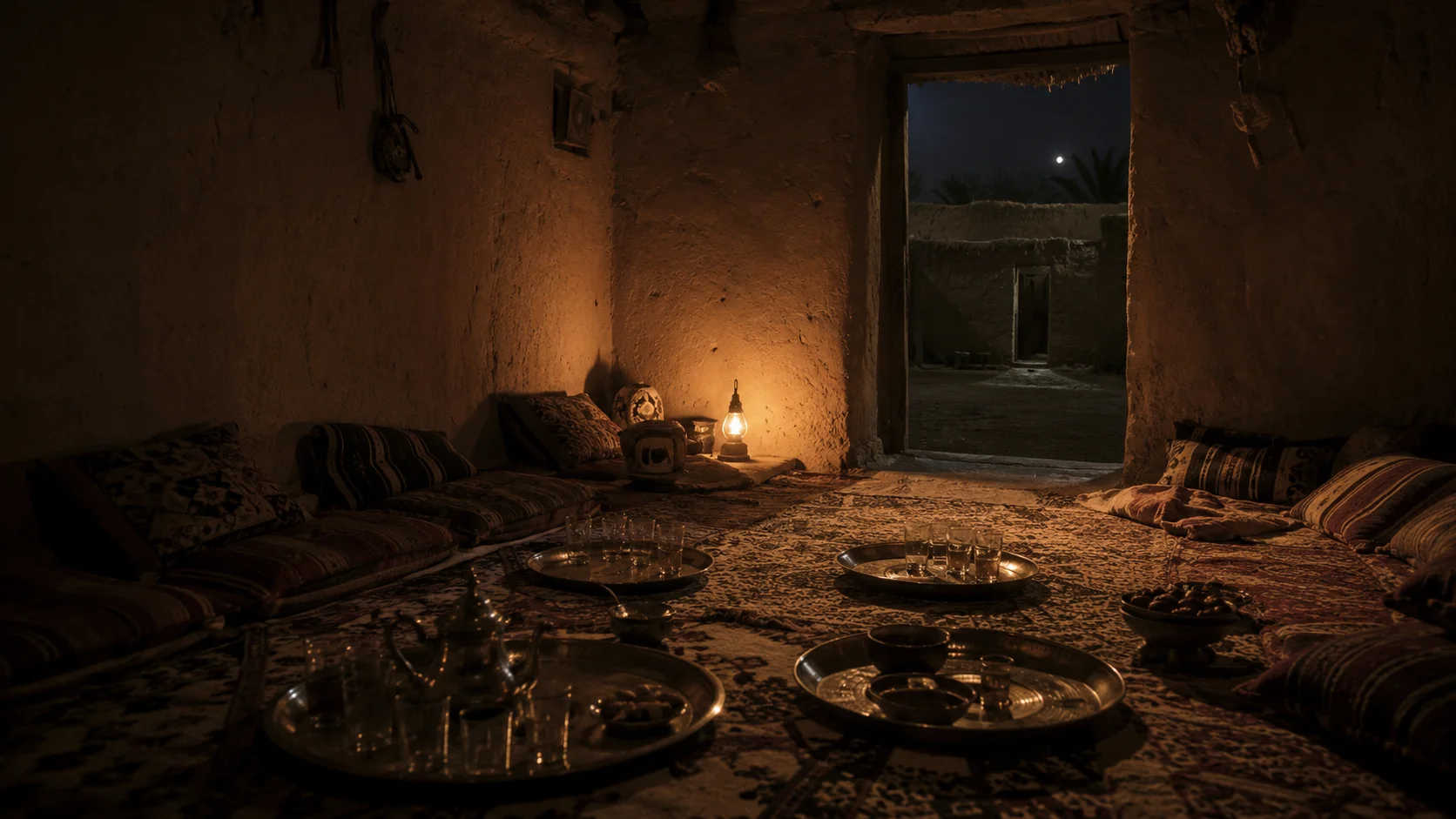
At night, when the house settled, the salon became almost mysterious. The same room that had been crowded now belonged to shadows. The carpets disappeared into darkness. A petroleum lamp might leave a small trembling circle of light. Outside, dogs barked in the distance, donkeys called, frogs answered near the water, and the oasis returned to its deep silence.
I knew the walls had heard more than I ever would. They had contained weddings, condolences, reconciliations, family decisions, Qur'an, laughter, arguments and meals. They had watched children grow into adults and adults become names spoken in memory. A room can become an archive without holding a single written page.
Years later, when I think of Ksar Meski, I do not first see a monument. I see people seated along those walls. I see hands reaching for bread. I see tea passing from one person to another. I see children at the entrance, waiting for their turn, learning without knowing they were learning.
Modern life has changed the shape of welcome. Houses are brighter, journeys faster, chairs more individual, meals more often divided. There is comfort in these changes. I do not reject them. But sometimes comfort creates distance without our noticing. A separate chair, a separate plate, a separate screen, a separate room—little by little, everyone can remain together while no longer sharing the same space.
The grand salon represented another idea. It asked people to adjust themselves to one another. To sit close. To wait. To listen. To share what stood in the centre. To accept that another person's presence would alter the rhythm of the evening. This was not always easy. That was precisely why it mattered.
I cannot return to the salon exactly as it was. Even if the walls remain, time has entered before me. Some voices are gone. Some faces live only in memory. The children at the entrance have grown older. The village has electricity, water and the signs of another age. But when I write, the room fills again.
The first greeting reaches the doorway. Cushions are adjusted. The gas bottle stands beside the maker of tea. Glasses shine on the round tray. Someone begins a story. An older man interrupts to correct him. The children hide their laughter. Bread arrives warm. Water is carried for ablutions. The Qur'an is opened. Night gathers beyond the walls.
And for a few pages, no one has left.
What This Place Taught Me
Hospitality is not measured by the size of a house, but by the place you make for others within it.
The grand salon taught me that generosity begins before anything is served. It begins in attention—in seeing who has arrived, who needs a place, who has not yet received a glass, who carries a story, and who may simply need to be heard.