Ma3zizti
The first thing memory gives me
is not her face.
It is her place.
Just to the right of the door, as we entered the small salon, my grandmother sat beside her large sinia for tea. Everyone in the house knew where to look for her.
We called her Ma3zizti. She was a simple and beautiful woman, slender, always dressed in a long robe and a headscarf. She was gentle with us children, and she could be very funny. She could also be authoritative. The same woman who made us laugh could end an argument with a look or a few words.
Her kindness was not weakness, and her authority was not coldness. Both belonged to her. We knew that she loved us, and we also knew that her patience had a limit.
She was a believing woman. She sometimes left the house to go to the mosque, but most of her life unfolded at home. This did not mean that she was cut off from people. People came to her. The house received them, and her place beside the door became one of the places where family life and village life met.
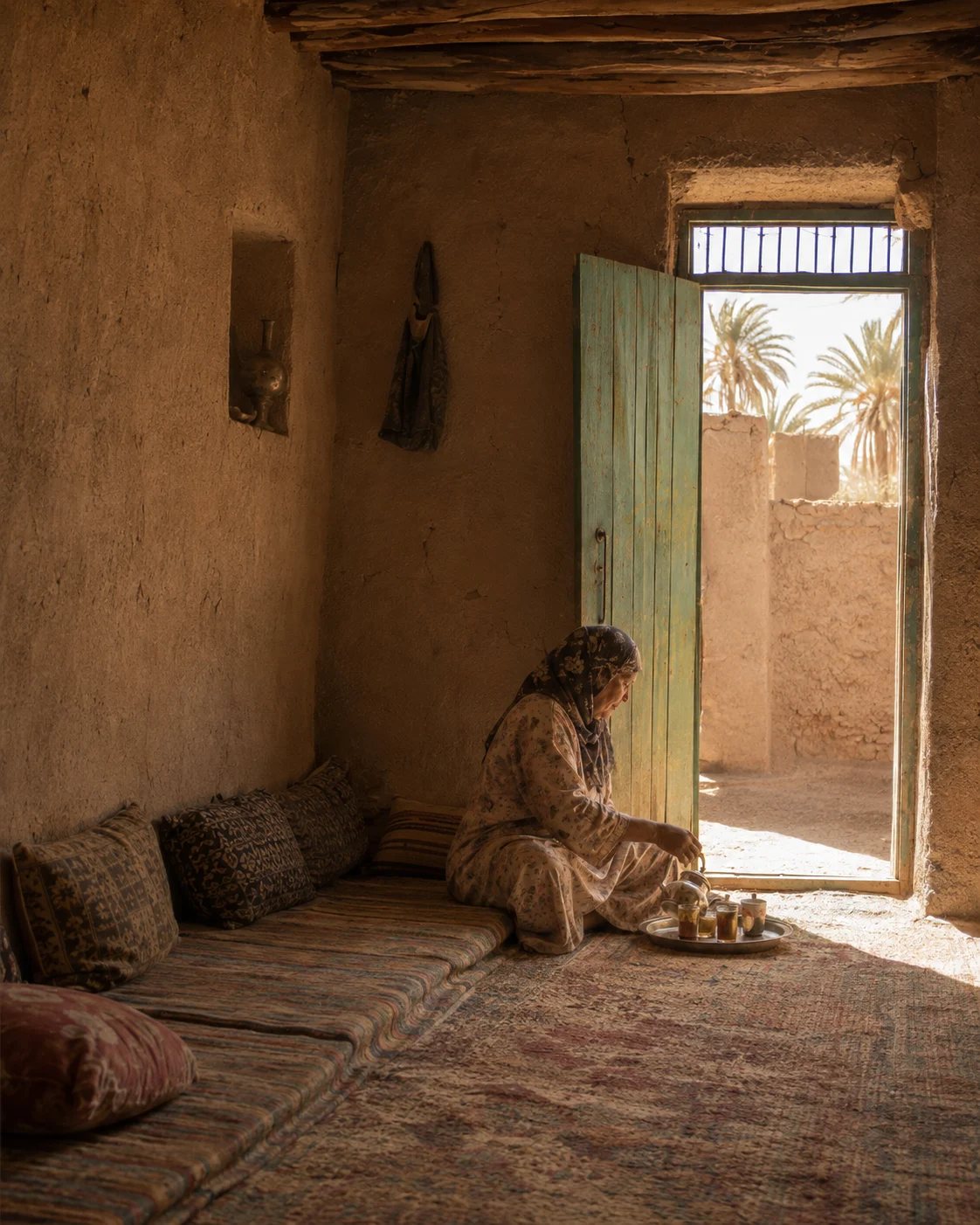 Historical visual reconstruction based on family memory
Where We Expected to Find Her
Children entered, women crossed the room, neighbours arrived, tea was poured, and conversations changed around her. Her place did not need to be reserved. It was already hers.
I remember the position clearly: the door opened, and she was there on the right. The certainty of finding her was one of those quiet assurances a child never thinks he may lose.
We believed that rooms kept people. We did not yet know that it was often the person who kept the room alive.
Tea, Coffee,
and the Smell Before the Cup
She prepared the tea herself. She also made coffee with spices. I never saw exactly which spices she used. I remember only that the smell arrived before the cup, and that the taste seemed to belong to her alone.
I have drunk good coffee in many places. None has brought back hers. Perhaps the missing ingredient was not hidden in the jar. Perhaps it was the room, the tray, the hand that served it, and the certainty that she was still there.
The House Came to Her
My grandmother did not need to move constantly in order to remain at the centre of things. Much of the movement came toward her. People visited. Children returned. Tea gathered those who had something to say and those who had come only to sit.
She had her own bedroom, but the small salon was where I remember her most clearly. Her room belonged to sleep and privacy. Her place beside the salon door belonged to the life of the house.
From there she could welcome, listen, laugh, refuse, correct, and decide. Nothing about it looked grand. Its importance became visible only later, after the chairless corner remained and the person who gave it meaning was gone.
Before the Flour,
There Was Her Patience
The wheat came from our family land. Before it became couscous, soup or bread, it passed through water, sun, hands, cloth, stone and time.
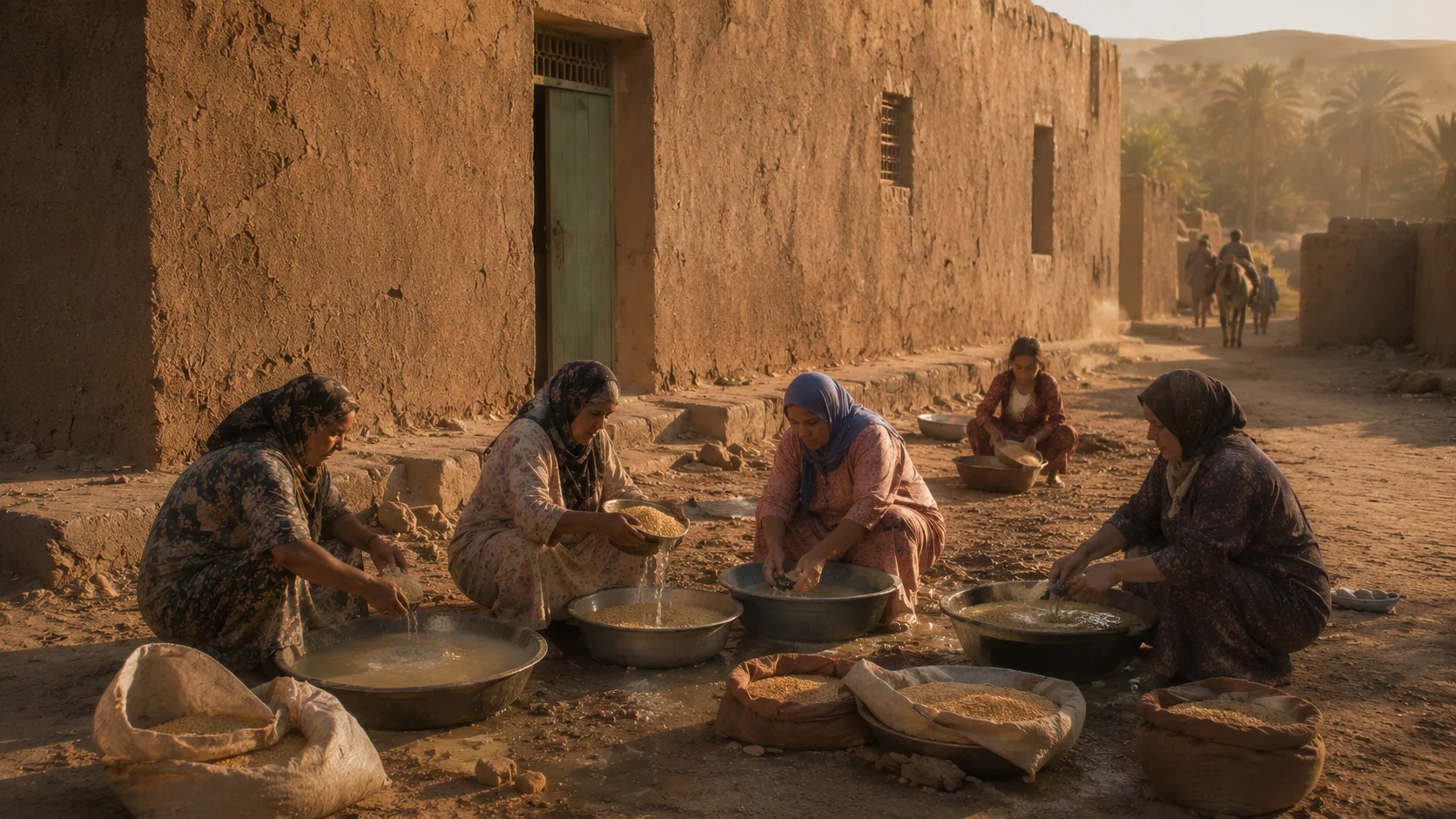 Historical visual reconstruction
Washed Before the House
The women washed the grain outside, where water, work and conversation could share the same ground.
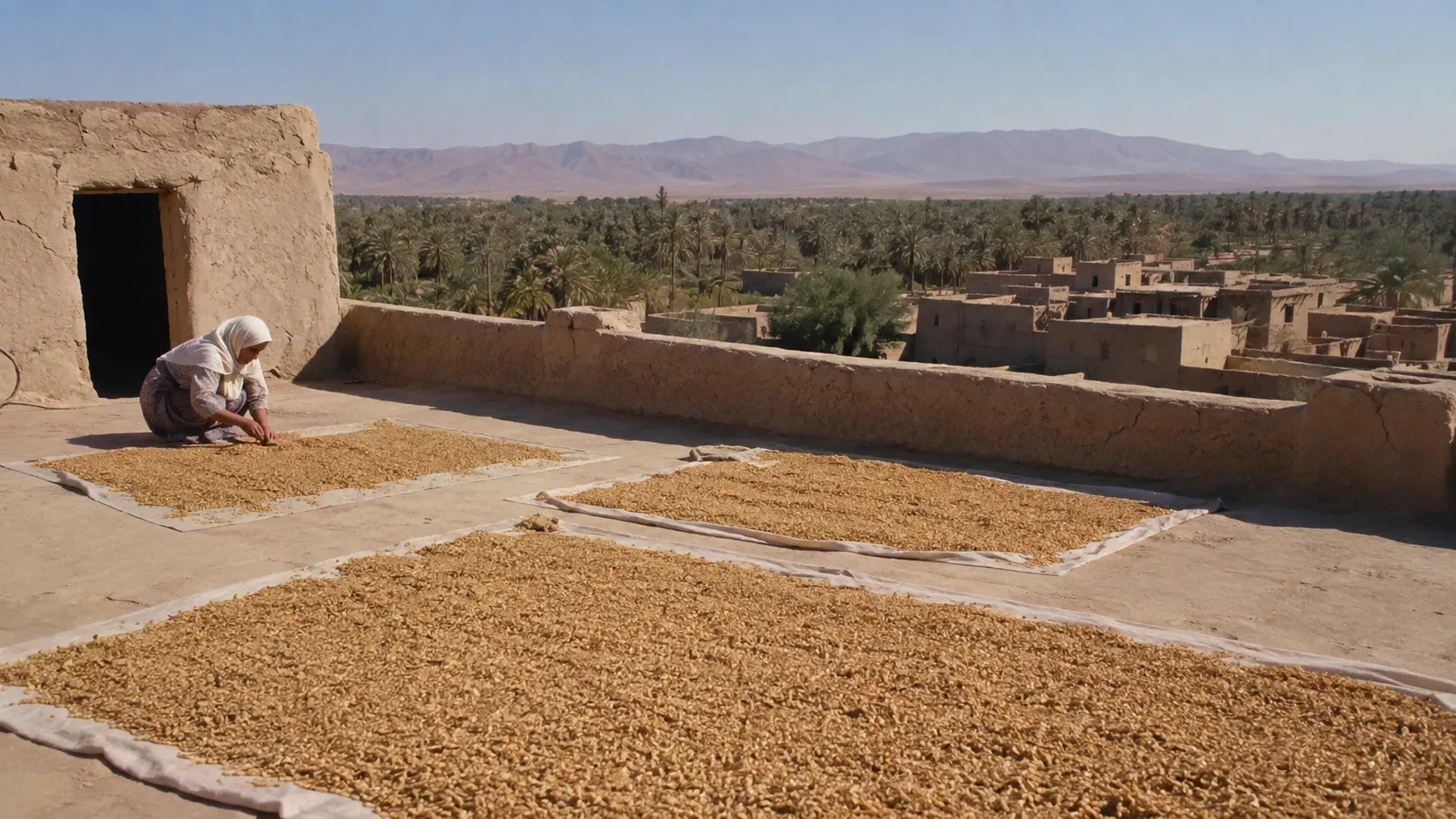 Historical visual reconstruction
Dried on the Rooftop
The roof received the grain as it received dates and other provisions: beneath open sky and desert sun.
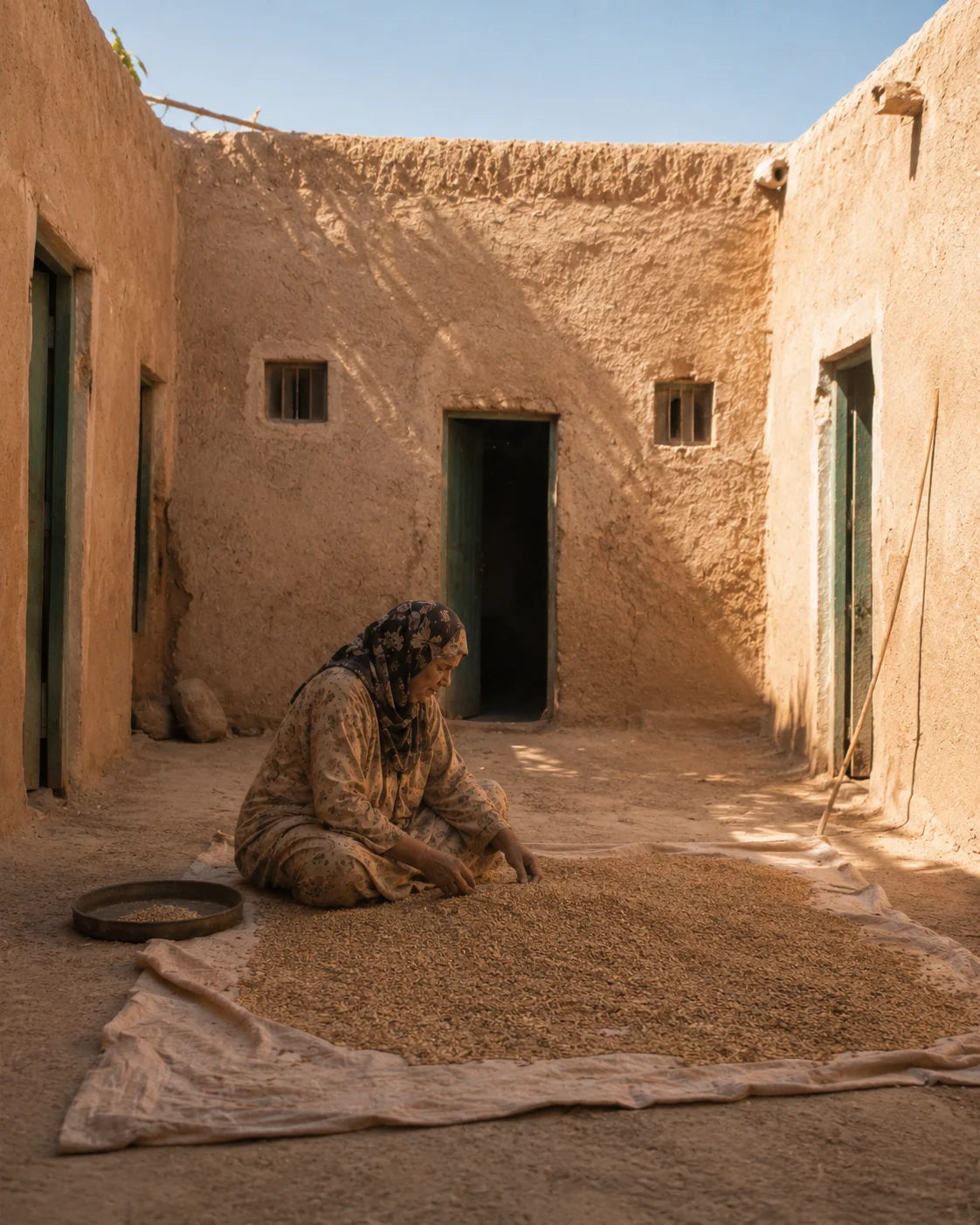 Historical visual reconstruction
Sorted in the Sariia
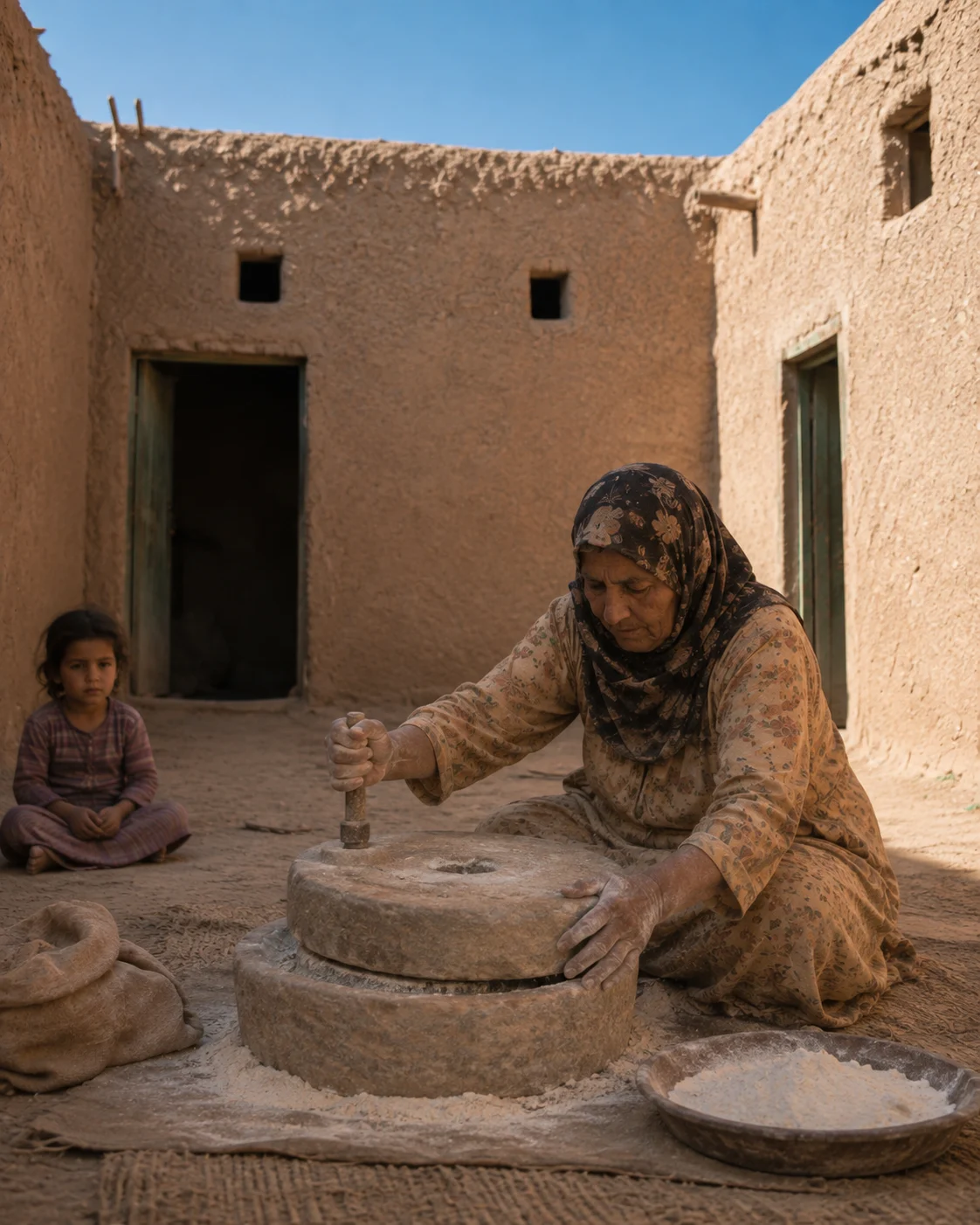
She spread a large cloth before her in the roofless centre of the house and cleaned the wheat by hand.
 Historical visual reconstruction based on family testimony
Stone Against Stone
She sat on the ground in the open Sariia before the old mill: two round stones, a central opening, and a handle turned by hand.
I watched her. I did not help. Childhood often receives the labour of others without understanding its weight. What I kept was the sound: the two stones rubbing, turning, returning, until grain became flour.
The other women of the household used that flour for couscous, soup and homemade bread. My grandmother did not have to prepare every dish to be present in what the family ate. Her work had already entered the food.
Red. Black. White.
A Little Green.
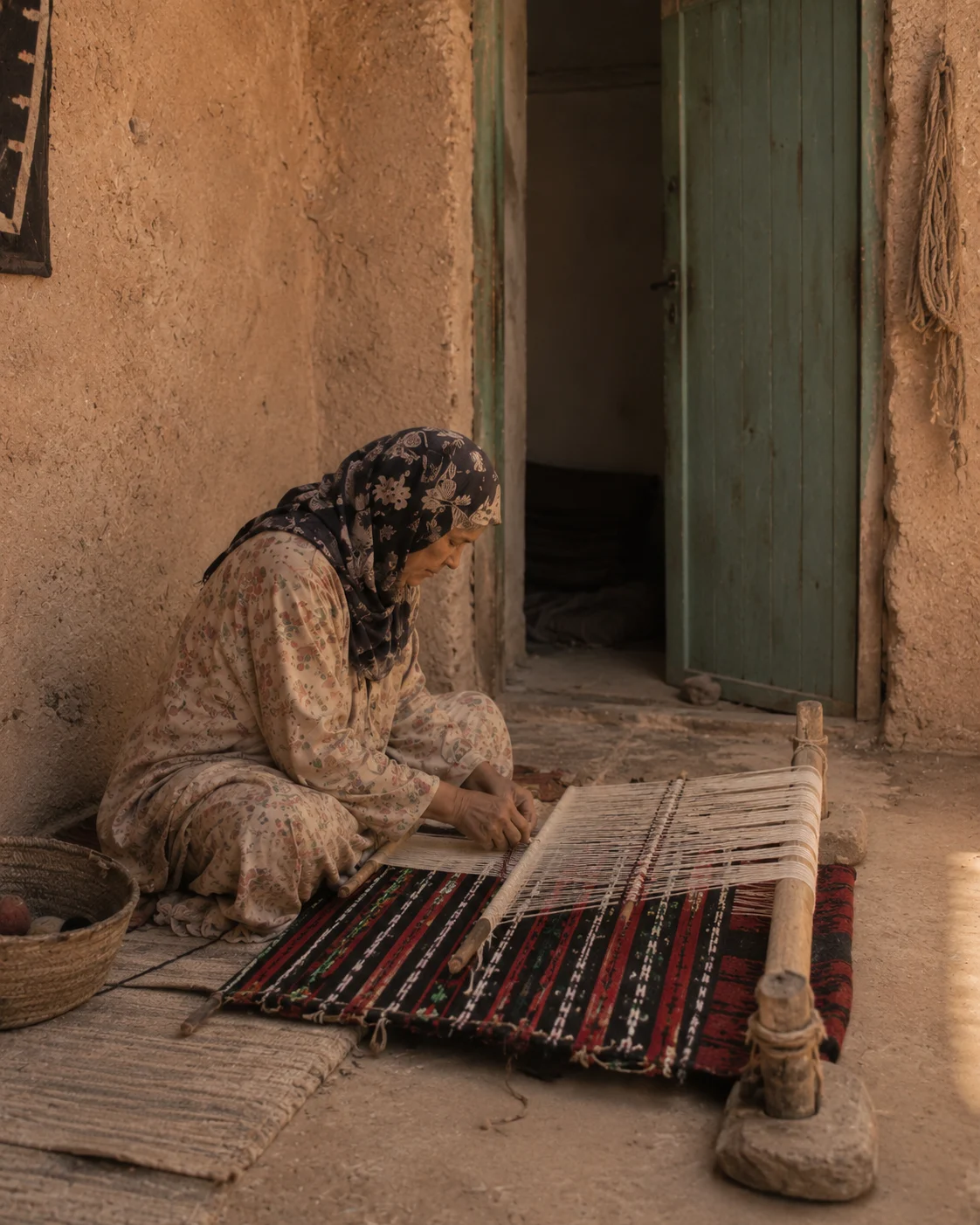
She wove carpets alone in front of the door to her bedroom. I do not remember every pattern. I remember the colours: red, black, white, and a little green.
The work belonged to the doorway, just as the wheat belonged to the Sariia and the tea belonged to the small salon. Her life was written through places and repeated gestures.
She did not announce that she was preserving a tradition. She was simply doing what she knew how to do. Tradition often looks ordinary while it is still alive.
 Historical visual reconstruction
 Historical visual reconstruction
The Leben
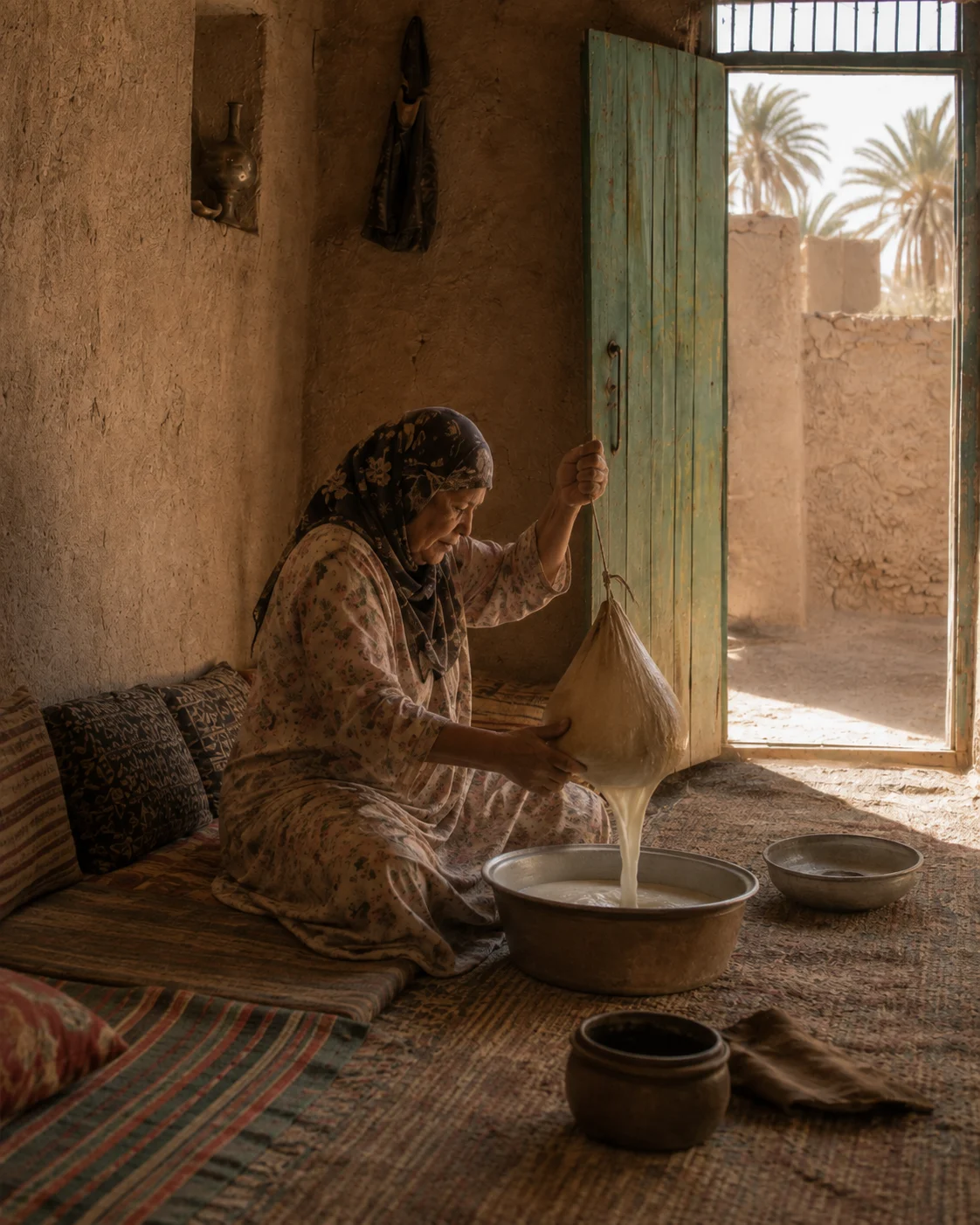
She also prepared leben in a goatskin. The movement was different from the stone mill, but it belonged to the same world: work repeated until milk changed.
The house had its own sounds. The stone mill. The loom. The tea glasses. The skin moving as the leben was made. None of them was recorded, yet each remains part of the house I hear in memory.
Not Every Memory Asks to Be Solemn
When I am asked for a memory that belongs especially to her and me, I think of zamita, and I laugh.
I do not need to enlarge the scene or force it into a lesson. Some family memories keep their truth in the smile that returns with a single word.
A Faith Without Display
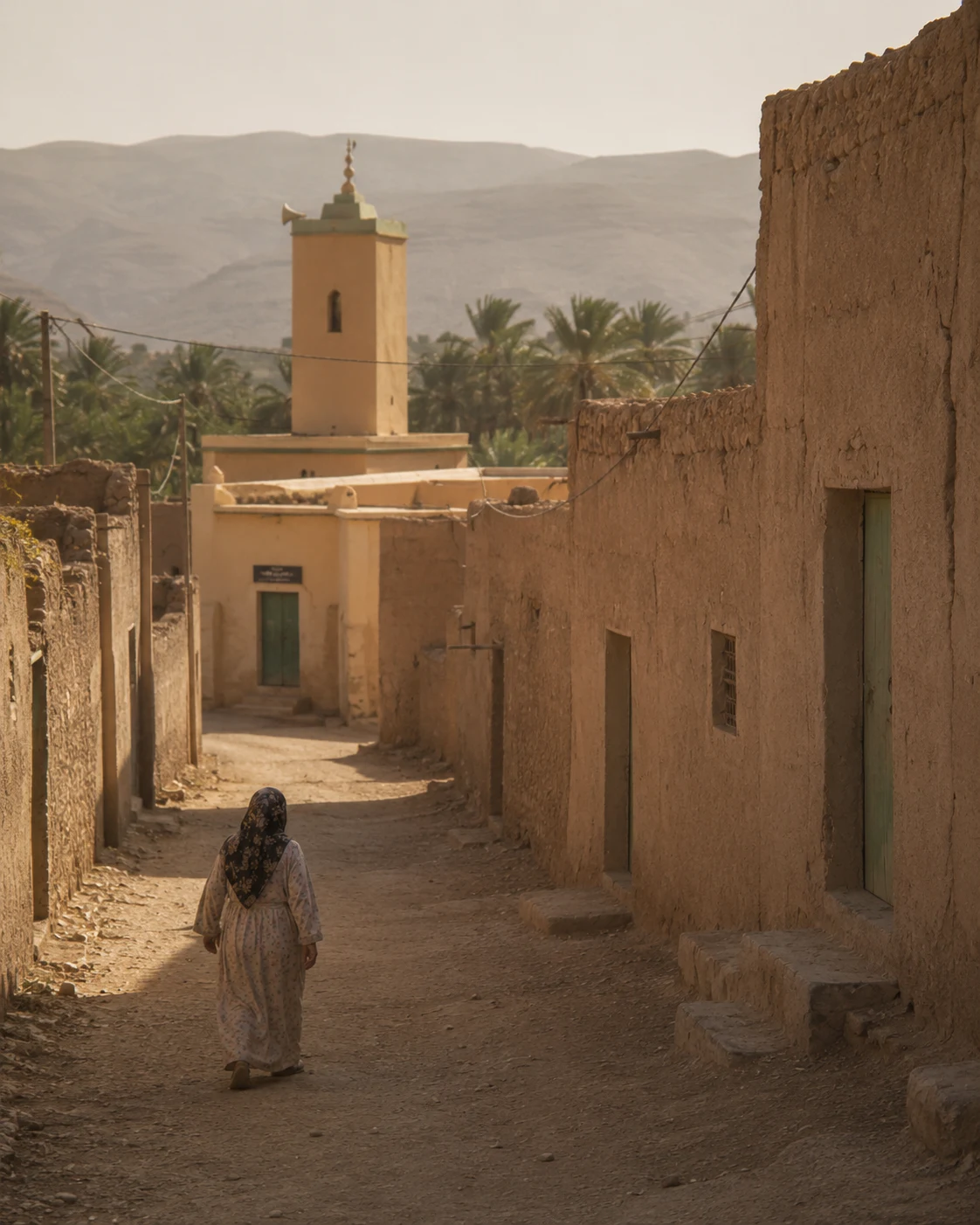
Her faith was part of her life, not an ornament added to it. She went to the mosque, and she returned to the house where work, prayer, family and responsibility were never completely separate.
I do not remember speeches. I remember a woman who believed, who kept her place, who welcomed people, and who could be tender and firm without seeing any contradiction between the two.
 Historical visual reconstruction
What I Would Ask for Now
I do not wish that I had asked her for a secret recipe, a family date or some perfect sentence that would explain the past.
I wish I had spent more time sitting with her. I wish I had spoken with her longer. When we are young, we believe there will always be another glass of tea, another cup of coffee, another afternoon in the same room.
Her tea is missing. Her coffee is missing. But those are only the paths through which I reach the deeper truth: she is missing.
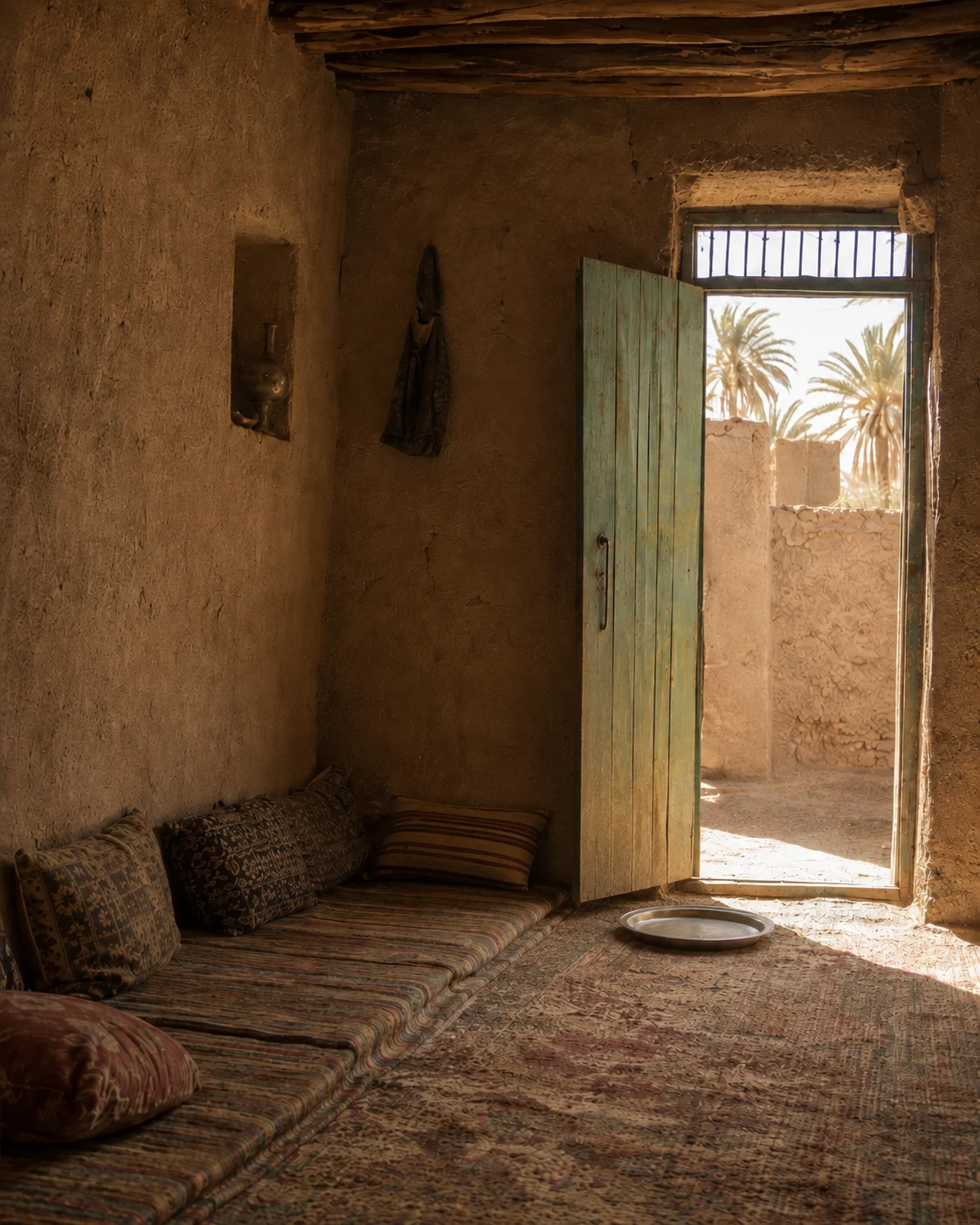 Visual reconstruction of remembered space
The House Did Not Gather Us in the Same Way
Since she has no longer been there, a feeling of emptiness has remained. The relationships are not the same. Each person has taken a different road.
It would be too simple to say that one person controlled an entire family. That was not her role. Her presence created a centre. People came, sat, returned, and found one another around her.
We called her grandmother. Only after she was gone did we fully see that she had also been one of the pillars of the house.
I remember her beside the door, with the sinia near her, the house moving around her, and none of us yet understanding that we were living beside the centre of our family.
The stone mill has fallen silent. The coffee cannot be remade. The place remains. And because I remember where she sat, she has not disappeared entirely from the room.
اللهم ارحمها وارحم موتى المسلمين أجمعين
O Allah, have mercy on her and on all deceased Muslims.