One village · Two horizons · Two generations
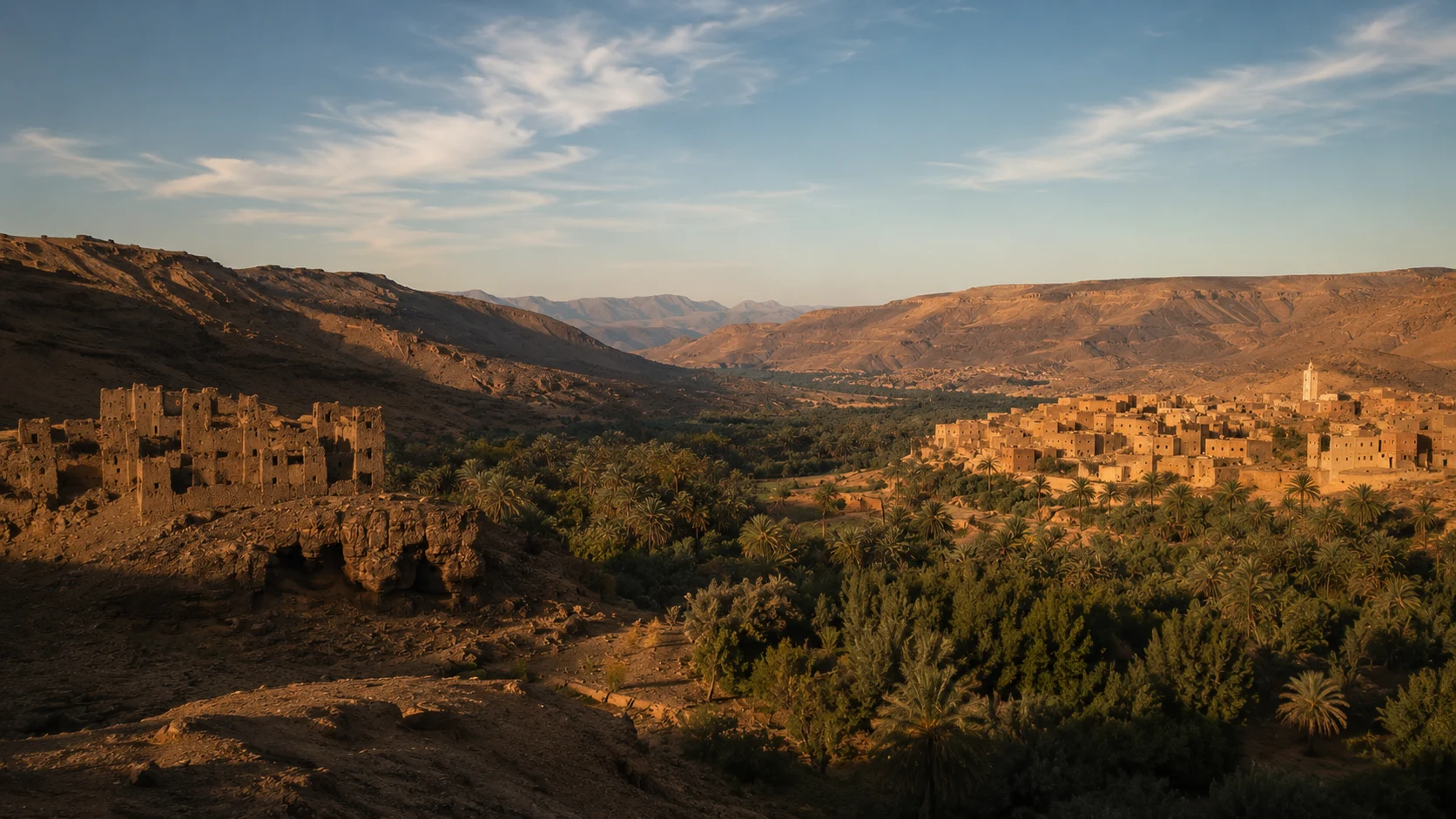
Across the valley,
two silhouettes face one another.
One still carries the movement of the present. The other stands open to the sky. They are not two unrelated villages. They are the two faces of Ksar Meski.
Between those two births lies the story of one Arab village carried from one horizon to another.
Ksar Meski is a small Arab village of the Tafilalet, in southeastern Morocco. Its identity did not begin in a recent book, nor in a description written by a visitor. It was carried for generations in the Arabic spoken from one doorway to another, in family names, in the teachings of the mosque, in the authority of the Jmaâ, and in the memories transmitted from fathers to sons, from grandmothers to children.
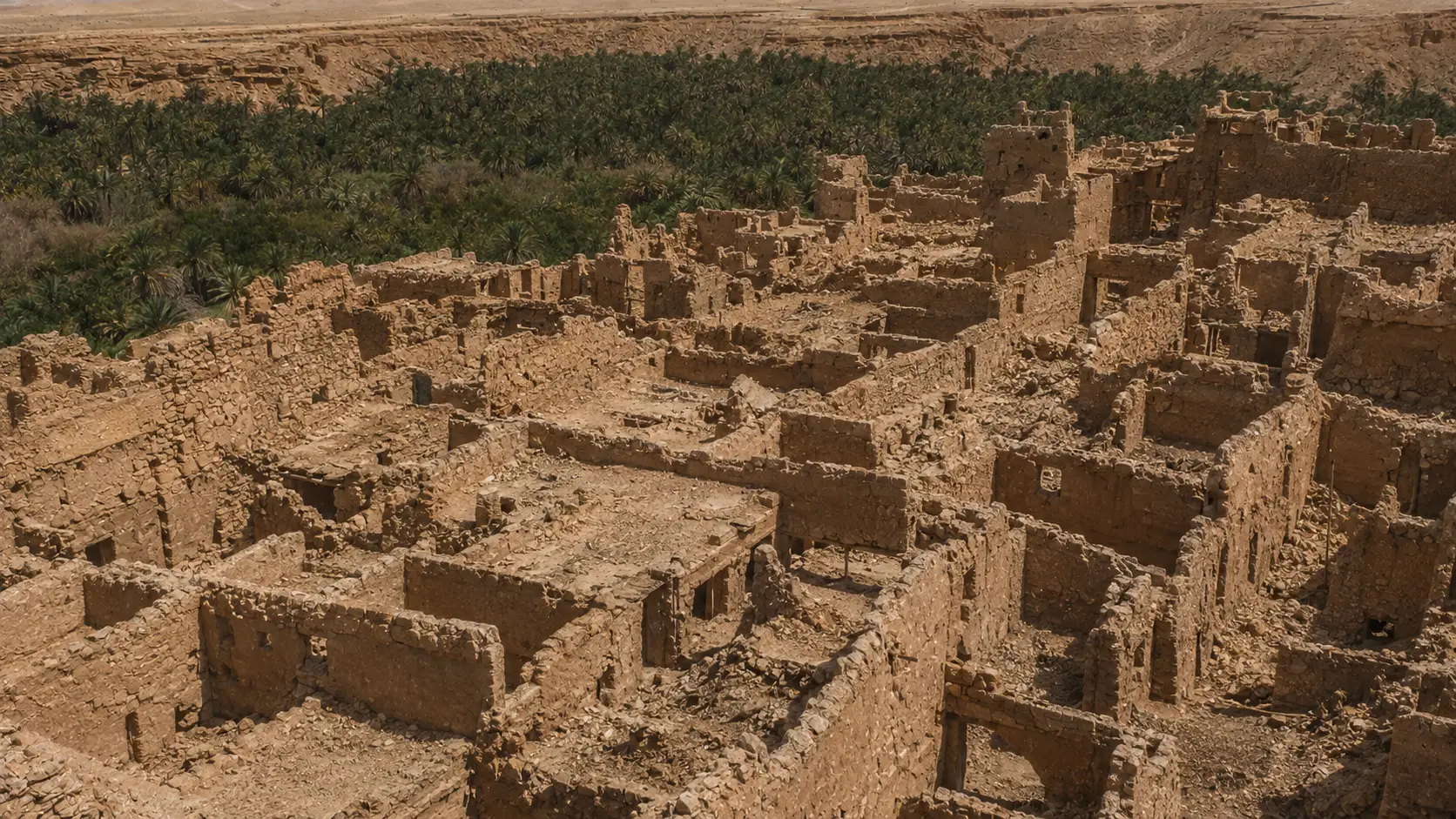
The village known today stands on one side of the valley. Across from it, beyond the oasis and the rocky descent, are the remains of the Ksar where my father was born. From a distance, the old earthen mass appears almost sculptural: a beautiful ruin above the palms, admired by people who never heard the rooms breathe.
But ruins are the final appearance of a place, not its first truth.
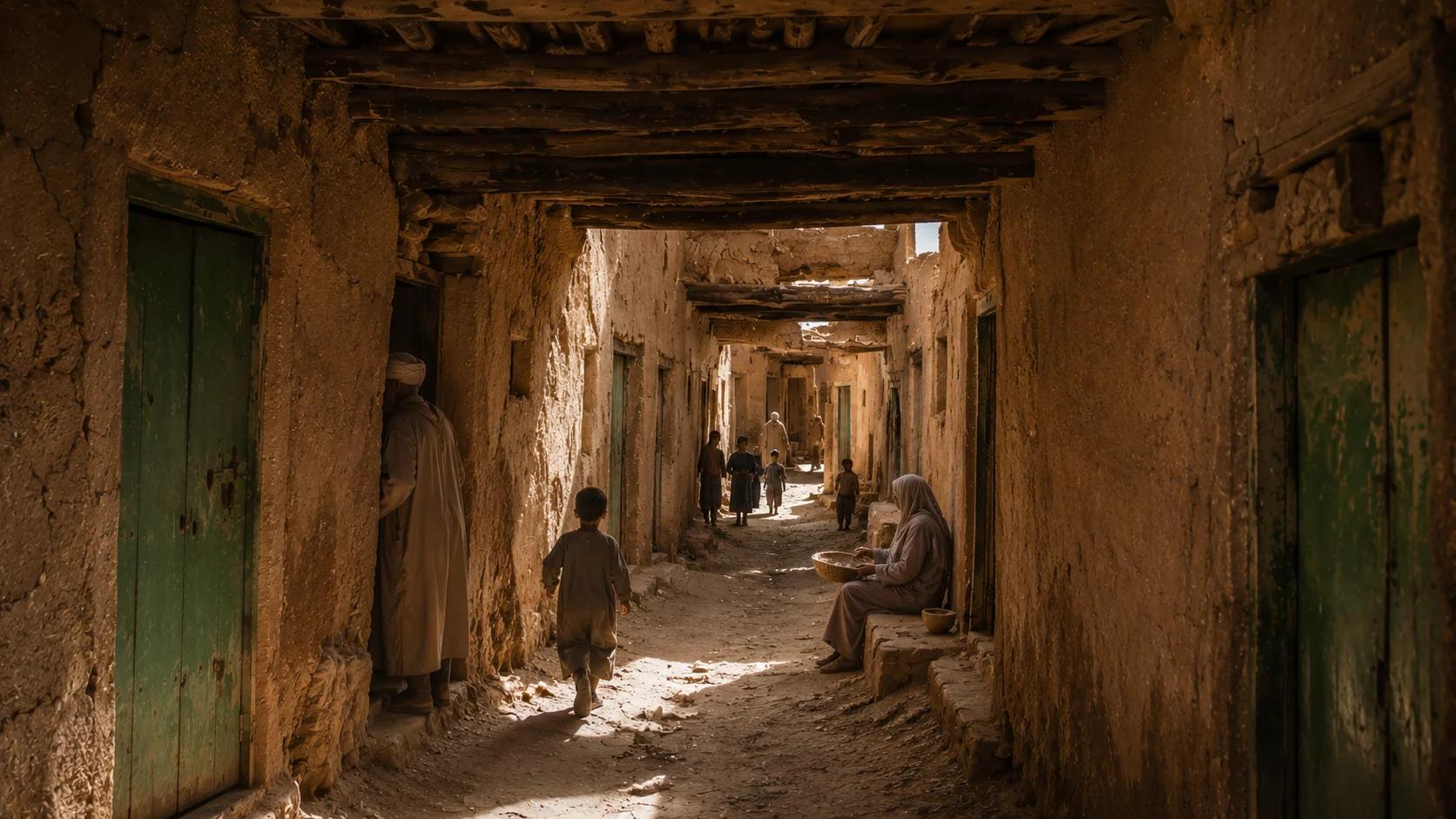
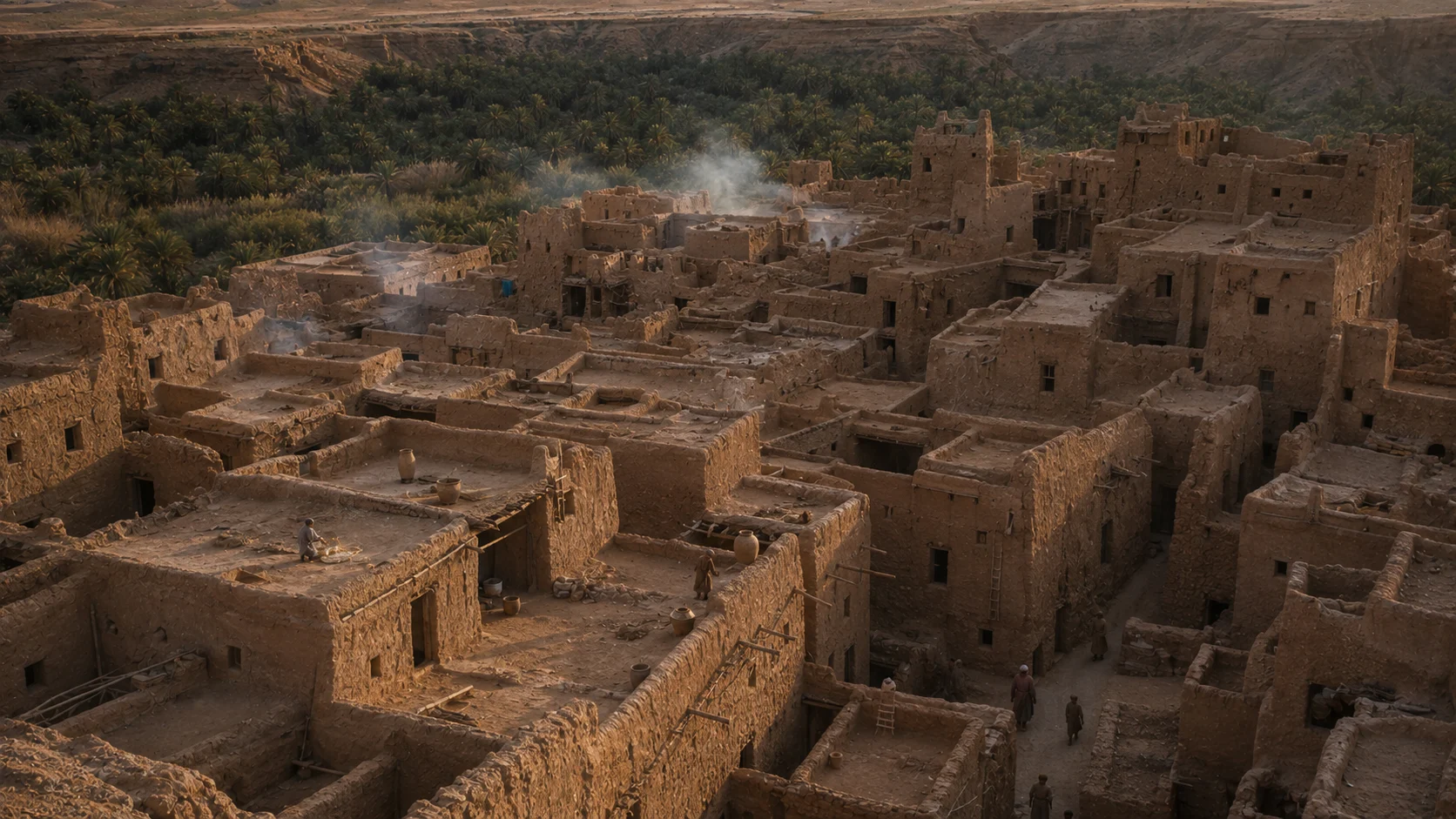
The old Ksar was not built without roofs. It was not born empty. It was once a dense inhabited fortress: houses leaning into other houses, covered derb, passages where daylight entered only through openings, doors leading toward family, neighbours, prayer and trade. What the sky possesses today once belonged to timber, earth and shelter.
My father remembers that village from within. I first knew it from across the valley, then from childhood journeys into its silence. He remembered neighbours where I saw collapsed rooms. He remembered roofs where I saw the open sky. He remembered home where I felt the unease of abandonment.
This chapter is not a contest between two villages, and no person stands at its centre. The subject is Ksar Meski itself: the community that lived once beneath the roofs of the old fortress, then slowly built again across the valley without becoming another people.
One Village Carried Through Time
- 01The Living FortressMy father’s Ksar beneath the roofs
- 02The Mosque and the DerbLearning, neighbours and daily life
- 03The Valley BetweenFloods, distance and accumulated hardship
- 04Building AgainThe Jmaâ, shared labour and new homes
- 05My KsarThe well, open doors and my childhood
- 06What RemainsA different rhythm, the same name
When my father speaks of the old Ksar, he does not begin with ruins. He speaks of enclosure, shelter and nearness. The houses were joined so closely that the village seemed less like a collection of separate homes than one great inhabited body. The covered derb passed beneath roofs, and the people passed beneath them as members of a community accustomed to living near one another.
To walk there was not to cross the open streets of the new Meski. It was to move through shaded passages, under timber and earth, between walls that carried rooms above. The old Ksar held darkness differently: not the darkness of abandonment that I later feared as a child, but the cool shade of a place built against heat, wind and exposure.
From outside, it may have resembled a single fortress. Inside, it was divided by family life: one doorway, then another; a neighbour close enough to hear; children moving between relatives; commerce, prayer, work and conversation contained within the same earthen form.
 Historical visual reconstruction
A Village That Felt Like One Great House
My father corrected an image I had carried for years. I thought of the old Ksar as a place of streets. He spoke instead of derb: covered passages, roofs above, houses touching, and a village whose architecture kept people close.
This was one reason he preferred it. It felt quieter and more familial. There was less mixture with people unknown to the community, and a stronger feeling that those around him belonged to the same intimate world.
His preference was not a theory about history. It was the memory of a child who had once known nearly every presence around him.
The House Beside the Mosque
The family house stood beside the mosque. There was no school inside the old Ksar, and my father learned Arabic and the Qur’an there.
The mosque belonged to daily formation as much as to prayer. It was where a child learned letters, recitation and discipline, a few steps from the house where his parents lived. The distance between home and learning was not measured across a town. It existed within the same close fabric of the Ksar.
I try to imagine him walking through the covered passage, leaving one familiar doorway and reaching another familiar place, carrying no idea that decades later the roof above that route would be gone and his son would stand beneath the open sky trying to rebuild the scene through words.
The First School Was the Mosque
My father did not describe a classroom in the old Ksar, because there was none. He described the mosque, the place where children learned Arabic and carried the Qur’an into memory.
The family house was beside it. Faith, language and home stood almost within the same breath.
The Family Everyone Called the Chorfa
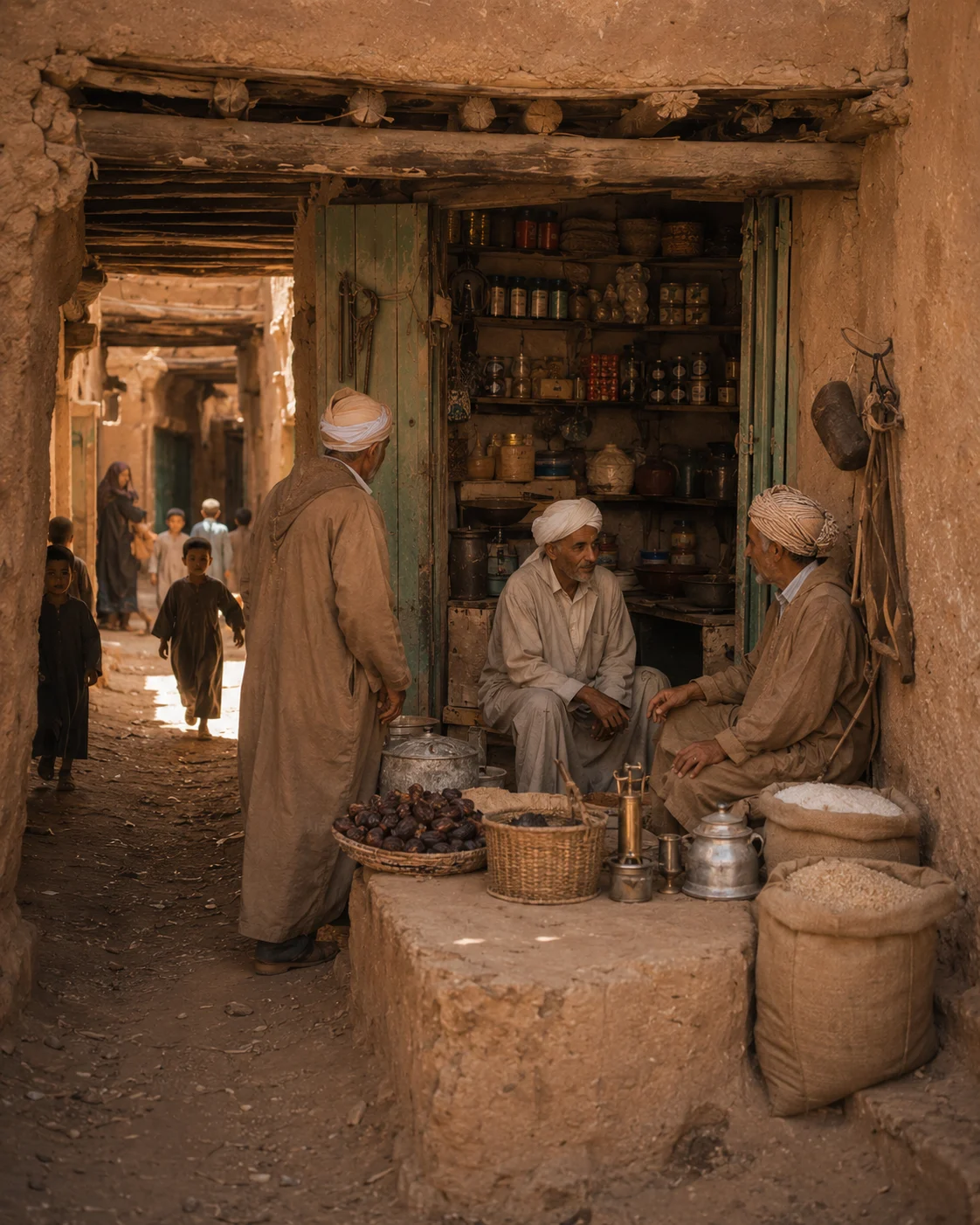
Among the inhabitants were a family everyone called simply the Chorfa. The name was not an academic term introduced from outside. It belonged to the vocabulary of the village and remains in use among people who know the family today.
They were remembered locally as a respected family associated with trade. They had a shop in the old Ksar, and later generations became known for business, property and shops in Errachidia and elsewhere.
The scene requires no grand portrait: a hanout, neighbours stopping, goods passing through hands, and a family name understood without explanation by everyone who lived there.
 Historical visual reconstruction
A Childhood Beneath Foreign Aircraft
My father was a child during the final period of French colonial presence. He remembers French forces arriving near the village and waiting for the inhabitants to leave. They did not. After two or three days, the soldiers withdrew.
Some days later, a helicopter passed above the Ksar. My grandmother pulled her son toward her to protect him. She prepared herself to defend her child with whatever was at hand. The aircraft did not attack. It released papers announcing the end of colonisation.
I do not retell this moment as a military history. I preserve it as my father remembers it: the fear of a child, the instinct of a mother, the sound above the roofs, and pieces of paper falling where danger had been expected.
Paper Fell From the Sky
A mother pulled her child close. The village looked upward. What descended was not fire, but leaflets announcing that an era was ending.
The Village My Father Preferred
More than one person from that generation said the same thing: they preferred the old Ksar.
My father’s reason was simple. It was quieter. It was more familial. The community felt closer, and there was less mixing with people unknown to the village.
To someone looking only at the ruins, this preference may be difficult to understand. The old Ksar appears confined, fragile and remote. But comfort is not measured only by access, and belonging is not measured by the width of a street.
He was not praising poverty, danger or isolation. He was remembering the density of human life: parents near, neighbours known, the mosque beside the house, the covered passage, and the feeling that the village held its people inside a single shelter.
 Historical visual reconstruction
Why the Roofs Disappeared
The absence of roofs is sometimes treated as if it were part of the original beauty of the ruin. It was not.
When the new village was being built, some families had little. Timber was valuable. Certain inhabitants recovered the old beams from the roofs of their former homes and used them in the houses rising across the valley.
Because the houses were joined, the removal of one roof could weaken the structures beside it. Walls exposed to rain, time and open air became more vulnerable. What one family took in order to build again also changed the fate of the homes that remained.
The old Ksar was therefore not merely abandoned. Part of it crossed the valley.
 Historical visual reconstruction
The Valley Could Become a Barrier
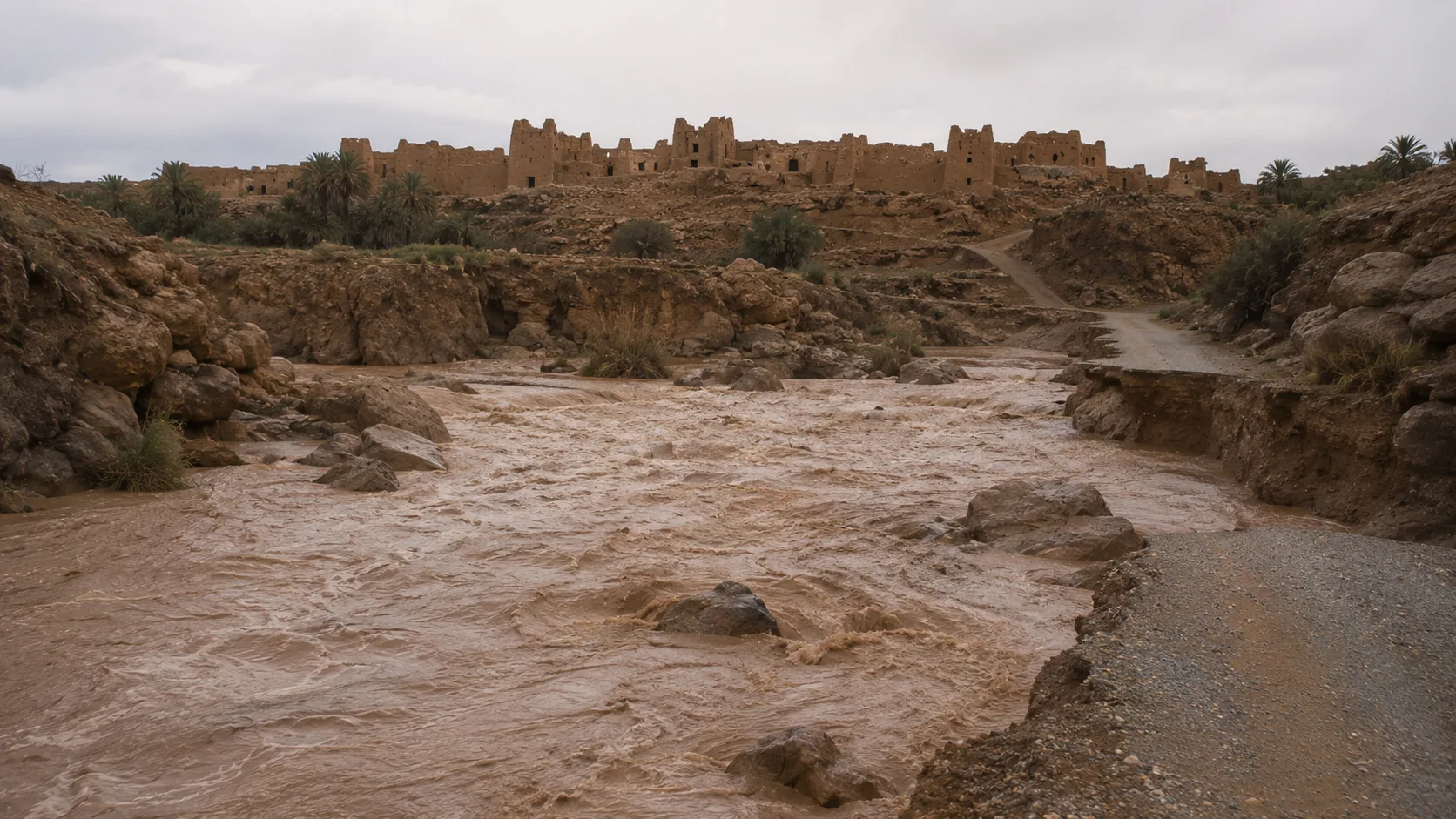
The old Ksar stood far from the road. When the oued flooded, access could be cut and the inhabitants could remain trapped away from the route beyond the valley.
My father remembers once being unable to return for a long time because the water had made the passage impossible.
There was also a major flood in the region, destroying houses in neighbouring villages and damaging cultivated land. Later came the construction of the dam at Errachidia.
No single event explains the move. Distance, isolation, floods and the demands of a changing life accumulated until remaining became harder to defend.
The First Question Was Not How to Leave
It was how to continue.
A village is not moved by lifting its walls. It must carry relationships, authority, labour, prayer, memory and the difficult agreement of many families.
The old Ksar had sheltered generations. Yet the road remained far, and the oued could turn geography into confinement. Difficulties that had once been endured began to point toward another future.
The decision did not erase affection. My father could understand why the move occurred and still prefer the place that was left.
Before the village crossed the valley, it had to imagine that home could exist on the other side.
The Jmaâ would choose. Families would build. The old Ksar would remain inhabited while the new one slowly rose.
Part II · Building Again